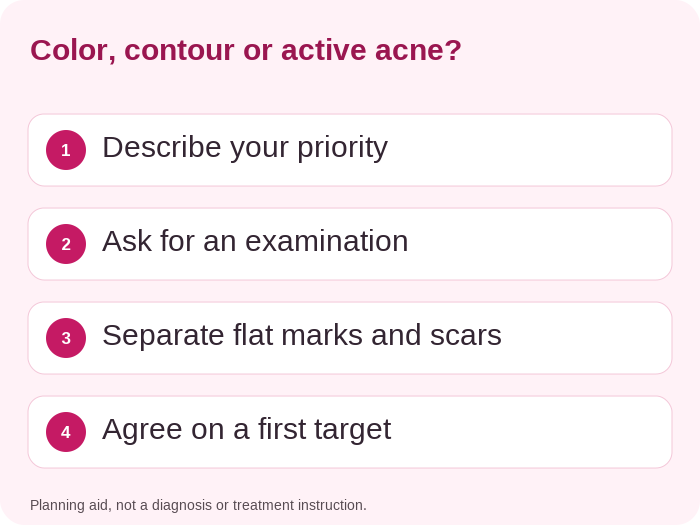
How can I tell acne scars from acne marks?
A flat color change after acne is usually a mark rather than a structural scar; depressed or raised areas change the skin’s contour. An examination can identify mixed findings and remaining acne. Treatment planning should separate color, scar shape and active breakouts, with realistic goals for each rather than one promise of completely smooth skin.
A change in color is not the same question as a change in contour
After acne settles, you may see a flat red, brown or darker area, a dip in the surface, a raised firm area, or more than one of these. A flat mark can reflect a response to inflammation; a scar involves a change in the skin's structure. Both may concern you, but they need different assessments. A photograph cannot reliably establish a diagnosis, and color can look different across skin tones or lighting conditions.
At the consultation, point to the feature you want addressed first. Ask the clinician to examine the skin in person and explain which areas are mainly color changes, which are scars and whether any active acne remains. If the answer is mixed, ask what the first stage of care would target. A treatment chosen solely because it is advertised for acne may not address your main concern.
Control active acne before committing to scar procedures
A scar plan may start with managing ongoing breakouts. New inflamed lesions can create further marks or scars while you are trying to improve older ones. The American Academy of Dermatology notes that scar treatment often begins after acne is under control, with an ongoing prevention plan. This does not mean everyone must wait the same length of time; it means the clinician needs to explain the sequence for your situation.
Bring a list of prescriptions, over-the-counter products and procedures you have used, including dates and reactions. Tell the doctor about current or recent isotretinoin and any medicines or conditions that affect healing. Do not stop a prescribed medicine for an appointment without asking the prescribing clinician. The treatment history helps the clinician decide whether a procedure should be adjusted, delayed or avoided.
Map the scar rather than asking for one device
Depressed scars can differ in shape and depth, and raised scars require a different approach. The AAD describes options that can include scar surgery, laser resurfacing, peels, microneedling, injections or combinations, depending on the scar and the person. Not every option is suitable for every scar, and none should be presented as a guaranteed eraser. Ask the clinician to identify the types they can see and which individual features are most likely to respond.
A practical comparison is to ask each clinic for a written plan for the same small area. What is the intended target? Which step is proposed first, what healing is expected, and when will the result be reassessed? If a package contains several technologies, ask why each is included and whether it is optional. The most comprehensive menu is not automatically the best plan.
Ask how your skin responds to inflammation
Skin tone and individual history matter when considering a procedure that causes controlled injury. Tell the clinician if insect bites, burns, acne or previous treatments left dark or pale marks for a long time, or if you have developed a raised scar. Ask how your history affects the proposed depth, settings and recovery plan. A patch or test area may be discussed in some circumstances; it cannot guarantee that a larger area will respond identically.
Do not treat skin color as a simple device setting that can be chosen from an online chart. A safe plan includes a current examination, your recent sun exposure, medication history and a way to obtain review if a reaction is prolonged. Ask who will perform the procedure and who can assess a complication if the original operator is unavailable.
Set a goal that can be checked honestly
A realistic goal might be to make a particular set of depressions less noticeable, reduce the contrast of remaining marks, or prevent further acne while you decide about procedures. Ask what is unlikely to change and how many visits might be required before a meaningful assessment. Improvement may be gradual and uneven. Avoid comparing a photograph taken immediately after one treatment with a long-term result presented in different lighting.
Agree on a way to record your starting point. Unfiltered photographs at a consistent distance, angle and lighting can support a discussion, but do not capture discomfort, downtime or how much the plan costs. Record those separately. If there is no improvement, ask when the clinician would reconsider the diagnosis or stop repeating the same approach.
Make a trip plan that does not assume the best case
If you are traveling to Korea, distinguish a diagnostic consultation from a course of treatment. Ask whether the proposed procedure has a review visit, what visible healing may involve and how long you should remain accessible to the clinic. Do not schedule a major event or long outdoor excursion immediately after a procedure without discussing the actual treatment and its aftercare. A return flight is not proof that a healing reaction has resolved.
Before leaving, request the treatment name, date, treated areas, relevant device or product details and written instructions. Ask for a contact channel and response hours, as well as the symptoms for which you should seek local urgent care instead of waiting for a reply. A clinician at home may be able to continue acne care or assess a concern, but arrange that connection rather than assuming it exists.
A home-care bridge between appointments
If treatment is staged, ask which regular acne medicines should continue and which topical products should be paused around a procedure. A written plan should identify the product, the affected area and the circumstances for restarting it. Explain whether you are likely to travel between different climates or have limited access to the same prescriptions at home. Your clinician can then help design a routine that is realistic rather than dependent on a single visit.
Do not squeeze or pick lesions while waiting for care, and do not use an aggressive home peel to imitate a clinic treatment. If the skin becomes painful, swollen, increasingly red or otherwise concerning, ask a healthcare professional for advice. The purpose of the bridge is to reduce confusion between appointments, not to promise that every mark will disappear. Record any reaction with its timing and the product involved, so that the next assessment is based on more than a vague recollection.
Where a listed clinic can fit
Delight Dermatology Clinic is listed on this platform and describes an international Acne & Redness service, including assessment and management of inflammatory acne. It may be a useful consultation starting point when active breakouts still accompany older marks. Review the clinic profile and its official service page, and ask whether the clinician can assess the scar types you want discussed; the listed service does not promise a particular scar treatment or outcome.
Selection here is based on a relevant published service, not a ranking or a guarantee. Ask for the name and qualifications of the clinician, a separate assessment fee and an explanation of alternatives. You can consult another clinician, take time to compare a written plan or decide not to proceed.
Questions that expose the decision
Ask: which areas are active acne, flat marks, depressed scars or raised scars? What should be treated first? What improvement is plausible for each feature? What risk of a longer-lasting pigment change or scar is relevant to my history? What will the clinic do if I heal more slowly than planned? Can the course be reassessed between sessions rather than purchased as an inflexible package?
Also ask what happens after you return home and whether the same plan can be followed by a clinician there. Bring product names and photographs, but avoid assuming that a picture proves a result will be reproducible for you. It is reasonable to leave with information and decide later. A well-defined plan should remain understandable without a time-limited promotion.
Look at color and contour separately
A flat spot of color after acne is usually different from a scar that changes the surface contour. Depressed and raised scars also require different assessment. Rather than choosing a device from a photograph, ask a dermatologist to map the types of findings present. Mixed concerns are common: the same area can contain active breakouts, residual color and structural scars that should not be treated as one problem.
Make the consultation specific
Point to a few representative areas and explain what bothers you about each. Is it the shadow in side lighting, the color without makeup, or a raised area you can feel? Ask the doctor to show which features a proposed treatment may improve and which it is unlikely to change. This makes expectations more concrete than a general promise of smoother skin.
Control new damage first
The AAD explains that scar treatment commonly begins after acne is controlled, with ongoing treatment to reduce new breakouts. Bring the details of recent and previous acne medicines, including treatments from the last two years. Ask whether active acne changes the timing or type of procedure. A plan that addresses existing scars should also explain how new scars will be prevented.
Understand a staged approach
Different scar shapes may lead a clinician to discuss different techniques, sometimes in combination. Ask why the sequence is proposed and what will be reassessed between stages. A package name alone does not explain the intended mechanism. For a short stay, it can be more useful to establish a long-term sequence than to compress all available treatments into one visit.
Compare photographs fairly
Surface texture is strongly affected by lighting. Request photographs with consistent side lighting, angle and camera distance, as well as the interval after treatment. Ask whether the pictured patient received additional procedures. Choose a personal endpoint such as reduced shadowing in a particular area, while recognizing that improvement and complete removal are different goals. Keep your own baseline images for later discussion.
Compare the same finding in Korea and at home
Ask both your U.S. clinician and the Seoul clinic to identify which features are active acne, flat color changes or changes in skin contour. Request a plan tied to those findings rather than a single acne-scar package. Bring photographs and records of prior procedures, and ask how the clinic will document areas treated during this visit. If several techniques are proposed, discuss their sequence and the review needed before another step. A comparable quote should describe the same scar types and treatment area, not simply share the word resurfacing.
A mark that looks indented on a video call
A bathroom light above your head can cast a small shadow next to a flat brown or red mark. A front-facing phone camera can also smooth away a genuine indentation. Before a remote consultation, take a front view and an oblique view of the same cheek in ordinary daylight. Keep the originals without filters. Describe whether the area is flat to the touch, whether it changes color when your skin flushes, and whether painful new bumps still appear nearby. You are helping the clinician choose what to examine in person. Photographs alone cannot grade a scar.
If your main concern is color, ask what improvement could be expected without changing the surface of the skin. If you see shadows or depressions, ask the clinician to identify which areas have a texture change and how that changes the treatment choices. An estimate for one procedure may otherwise refer to an entirely different problem than the one you want treated. When new deep lesions are still appearing, include a plan for preventing further marks before buying a scar-treatment series.
For follow-up in the United States, keep your original photographs alongside the written assessment, rather than comparing an unfiltered image with a clinic photograph taken under studio lighting. Ask the clinician to name one observable outcome you can review together, such as fewer new inflamed spots, fading color, or a change in the depth of a particular scar.
Clinical reference · Listed clinic · International consultation
Patient questions
Can one treatment address every acne scar type?
Different scar shapes may need different approaches. Ask the clinician to map the main types and explain any proposed combination or sequence.
Why do my scars look worse in some photographs?
Side lighting and camera angle can exaggerate shadows. Compare images using consistent lighting, distance and expression, and judge change at the agreed follow-up point.