Before your visit
A thick, discolored or lifting nail can have a fungal infection, but an injury or nail psoriasis can look similar. If you are considering a treatment while visiting Korea, ask how the clinician will establish the diagnosis before you pay for a course or start medication. A dermatologist may examine several nails and take a small sample for testing. The answer matters after the trip too. Many nail treatments continue for months, and a nail needs time to grow before you can judge its appearance. [1–3]
Tell the story of one nail first
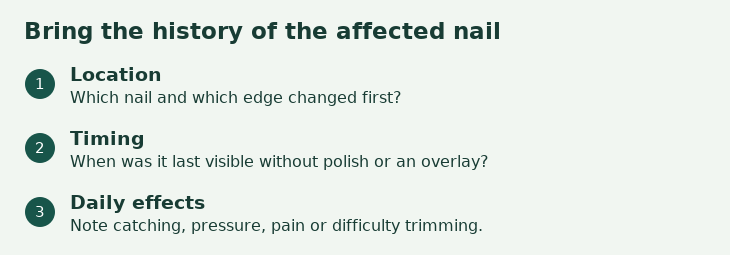
Pick the nail you noticed first. When did it change, and what did you see? Perhaps the corner turned pale and slowly thickened. Perhaps the nail lifted after a long hike in shoes that pressed on the toe. Or perhaps you first saw a change when polish came off and cannot say exactly when it began. All three are useful histories. Explain whether it hurts, catches on socks or has become difficult to trim. Describe any changes between the toes or on other nails, including the fingernails. You do not have to work out which details are medically important before speaking. [1, 2]
If you took photographs before the appointment, keep the dates. A picture taken before a recent injury may help show whether discoloration was already there. When comparing pictures, include the surrounding toe as well as the nail; a close-up alone can make it difficult to identify which nail or which edge changed. Mention if it was covered by a gel overlay or artificial nail for part of the period. Avoid forcing off an attached covering or cutting into the nail to produce a better photograph. Ask the clinic how they would like you to prepare for an examination.
When a change deserves a different appointment
A gradually thickening nail is a different issue from spreading redness, increasing pain and swelling around a toe, especially if you feel unwell. Seek prompt medical advice for those changes where you are. If you have diabetes, reduced circulation or a condition that affects immunity, tell the clinician early; a seemingly small foot problem may need closer attention. A new or changing dark streak in a nail deserves assessment as well. Mention the streak explicitly when booking instead of assuming every brown area is fungus, a bruise or old polish. The American Academy of Dermatology advises assessment of changes that can signal a melanoma under a nail. [4, 5]
You can ask for a medical nail examination even if the original concern was cosmetic. Someone who wants to wear sandals comfortably may also be worried about a change beneath the nail plate. The clinician needs to understand both the symptom and the decision you are trying to make. For example, say “the nail now catches on my sock, and I would like to know what is causing the change before I have it filed down.” This helps distinguish a request for an examination from a request for a particular service.
Why the dermatologist may examine apparently unaffected nails
Looking at the other toes and fingers gives the clinician context. One nail that changed after repeated pressure may tell a different story from several nails with similar surface changes. Psoriasis can affect nails, and the clinician may ask about changes elsewhere on the skin or discomfort in the joints. They may ask about time spent in communal changing rooms, previous athlete’s foot, earlier nail treatments and health conditions. Your job is to describe what you have observed and what you have already tried. Neither visiting a pool nor having a relative with psoriasis proves a particular diagnosis. [1–3]
Bring a list of any liquids, creams, polishes or tablets used on the problem. A phrase such as “something for fungus” can mean an over-the-counter skin preparation, a nail product, an oral prescription or a salon treatment. Show the original product name and ingredient if possible. Include how long you used it and why you stopped. Ask the clinic before changing a prescribed treatment or trimming the nail especially short in preparation for a visit. The clinician may have specific instructions for the examination or sample they intend to take.
What a nail sample does and does not answer
Depending on the situation, a dermatologist may take a clipping, scrape material from the nail surface or collect some of the buildup underneath. A laboratory or clinician can examine the sample for evidence of fungus. Ask what test is planned and whether the answer is expected at that visit or later. A microscope result discussed during an appointment and a result sent after you leave Korea create very different follow-up needs. Ask who will review the final result and what recommendation would change if fungus is found or if the test is inconclusive. [1]
You can use a simple question before committing to care: “If the test does not support fungal infection, what else would you consider?” A thoughtful answer might include reviewing trauma, nail psoriasis or another nail condition, depending on the examination. If your dermatologist is already confident of a particular diagnosis, ask what feature led to that judgment and whether testing would add value before a longer treatment. There is no single useful script for every nail change. The point is to understand why the chosen approach fits the nail in front of the clinician. [1, 3]
If the clinician confirms a fungal infection
Options may include a medicine applied to the nail or an oral antifungal. The choice depends on the extent of involvement and your medical history. A topical treatment can require regular application over a long period, and an oral treatment can involve interactions and monitoring considerations. Give the prescriber a current list of medicines and supplements. Mention pregnancy, pregnancy plans or breastfeeding where relevant. Ask for the generic drug name and whether a US clinician or pharmacy will be able to support the plan once you return. Do not take someone else's tablets to see whether the diagnosis was right. [1]
If you are offered a device treatment, ask exactly what benefit it is intended to provide. Is the aim improving appearance, treating a confirmed infection, reducing discomfort or making a thick nail easier to manage? What evidence supports that particular aim? Will you still need a medicine, and how will success be assessed? Ask to compare the time commitment, cost and uncertainty with a medicine-only approach or evaluation at home. A photograph shown immediately after a filing or cosmetic procedure cannot tell you whether a fungal infection has cleared. [1]
Agree on what improvement will look like
Nails grow slowly. The part already damaged may continue to look abnormal while new nail grows out from the base. This can be frustrating if your trip is short or an advertisement implies you will return home with a visibly different nail. Ask the clinician to show you where they will look for improvement and when comparison becomes meaningful. Find out whether the medication schedule ends before the old nail has fully grown out. Finish and review prescribed treatment as directed rather than deciding from one photograph that it has failed or succeeded. [1]
Record a baseline that matters to you. Does pressure in walking shoes hurt? Is trimming difficult? Does the edge catch during exercise? Alongside clinical findings, these observations make a later review more useful than judging everything by color. If pressure from footwear is suspected, discuss how to reduce it during a trip that involves a lot of walking. If you are buying new shoes in Korea, take the advice about fit with you. A helpful plan may include two separate aims: managing discomfort during travel and investigating the reason the nail changed in the first place.
A listed clinic for this consultation
Delight Dermatology Clinic is listed on Korean Skin Clinics. Its international medical dermatology page explicitly includes assessment and management of fungal nail infection. It is an appropriate clinic to contact about a possible fungal nail condition and the need to distinguish it from another cause. The published description does not specify that every laboratory test is available on demand. Before booking, ask what diagnostic options the clinic can arrange, when results are released and whether a visit can be devoted to examination alone. If you have a changing dark streak, describe that specific concern and confirm the appropriate medical pathway. [4, 6, 7]
Ask for an itemized estimate that separates the consultation from sampling, laboratory charges, medication and any proposed series of treatments. A lower initial fee can be difficult to interpret if results or follow-up are charged separately. If a result will arrive after departure, agree on a secure contact route, the language of the written report and who will explain it. If you cannot arrange suitable follow-up, ask whether it would be more practical to take the examination record to a dermatologist in the United States before starting treatment.
Questions to answer before your flight home
Do I have a confirmed diagnosis, a working diagnosis or a result pending? Those three phrases lead to different decisions. Write down exactly which nail was sampled and on what date. If you were prescribed a medicine, keep the generic name, dose as prescribed, planned duration and any monitoring instructions. Get a copy of any laboratory report rather than relying on a translated text message that says only “positive.” Your next clinician may need to know what the sample was tested for, whether the result was final and which organism was identified if the laboratory reported one.
What if I choose to wait? Ask the doctor whether observation is appropriate for your health history and which changes would make another assessment more urgent. If observation is reasonable, record a review interval and a contact route. If treatment is recommended, ask what could realistically be gained and what difficulties might arise if the condition is left untreated. You may want to start care closer to home to make monitoring easier. You should leave the decision knowing what the clinician thinks is happening under the nail, what uncertainty remains and how you will get an answer after the trip.
Sources & further reading
- American Academy of Dermatology · Nail fungus diagnosis and treatment ↗
- American Academy of Dermatology · Nail fungus signs ↗
- American Academy of Dermatology · Nail psoriasis ↗
- American Academy of Dermatology · Nail changes to have examined ↗
- NHS · Fungal nail infections ↗
- Korean Skin Clinics · Delight Dermatology profile ↗
- Delight Dermatology · Fungal nail service and international consultation ↗