Before your visit
If your braids, bun, extensions or ponytail hurt, loosen the style or change it. Repeated pulling can damage hair follicles, and waiting for a clearly bald patch can mean missing the stage when changing your routine could help. Thinning at the temples has several possible causes, though. A dermatologist can examine the scalp, ask about styling and shedding, and help you decide whether removing tension is enough or another condition needs attention. If you are choosing between a scalp spa and a medical appointment during a trip to Korea, the question to ask first is who can evaluate the hair loss itself. [1–3]
The first clue may be discomfort
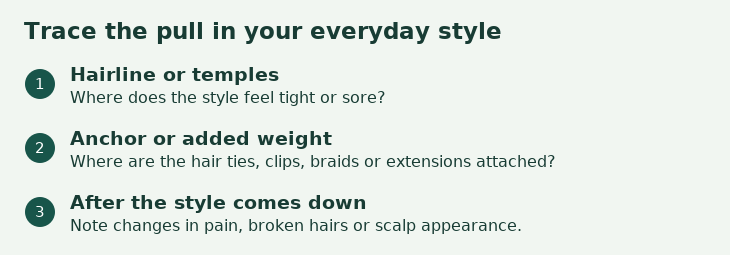
You may first notice a headache after a fresh style, tenderness at your edges when you undo a ponytail, or short broken hairs in the same place again and again. The American Academy of Dermatology lists pain, stinging and crusting as reasons to change a hairstyle that pulls. A style does not have to feel painfully tight every day for repeated tension to matter. Equally, symptoms such as burning or tenderness deserve attention even if you cannot see an obvious change in thickness. Tell the person styling your hair if a particular section pulls. You can ask for a looser finish right away. [1]
Look at the points where the style carries weight. A ponytail tied in the same position, long or heavy extensions, and tightly anchored braids can all put repeated stress on particular areas. These examples describe mechanical tension, not a judgment about a tradition, a texture or your reason for choosing a style. If your hair is covered at work or for religious reasons, consider the arrangement underneath as well. Explain privately what a typical day involves so the clinician can suggest changes that fit your actual routine. There is rarely just one acceptable way to wear your hair.
Describe the pattern you have noticed
Some people can point to a distinct area above an ear where the hair looks shorter. Others describe a wider part or more scalp visible only under overhead lighting. You do not need to know the name of the pattern before your appointment. Write down where you first saw a difference, whether it seems to be spreading, and whether the hair elsewhere feels less dense. Mention new shedding during washing or detangling if you have noticed it. These observations help a clinician distinguish changes in length, density and distribution, although none can give you a diagnosis on its own. [2, 3]
Try an example: “I first noticed broken hairs on the left side after taking down a style in August. The right side looks similar now, and the area stings while it is braided.” That history is easier to work with than “my follicles have stopped growing.” If the problem predates the style you suspect, say that too. If you noticed changes after an illness, childbirth, a medication change or a stressful period, put those events on the same timeline. Do not stop prescribed medicines because you suspect a link; ask the prescriber to review them. [2]
Two photos can be enough to start a useful conversation
One photograph can show the hairline with the hair resting naturally; a second can show where it is usually anchored. There is no need to recreate a painful style to take a picture. If you already have a photograph from when you wore it, that might show the placement well enough. Compare similar angles in similar light, keep the dates, and turn off beauty filters. Do not pull harder on one side to make the scalp visible. Report what you notice when you touch or wash your hair separately from what appears in a picture.
A clinician might ask to inspect the scalp beyond the area that drew your attention. Tell the clinic if your hair is in a style that takes several hours to remove, or if you need privacy before taking off a covering. Ask whether they would like it loose for the examination and whether you can speak with the clinician about this ahead of time. Arriving with a plan avoids sacrificing an expensive style unnecessarily or discovering at the appointment that the most important area cannot be seen. This is an access consideration, not a test of how seriously you take your symptoms.
What scalp imaging can contribute
Magnified imaging can document hair and scalp features in selected areas. Ask the clinician to point to the part of the image that informs the assessment and explain what decision it changes. One photograph of the hairline cannot stand in for a history, examination of other areas and, when indicated, further investigation. Hair loss can have more than one cause at the same time. Depending on the examination, a dermatologist may discuss tests such as blood work or a scalp biopsy to investigate a suspected condition. These are individual decisions, not a standard shopping list for every visitor. [2, 4]
If the consultation includes a printed or digital scalp score, ask what the number measures, how the image was taken and how it compares with your own future images. A different parting, different magnification or different location can make two images look quite different. Before you pay for a series of treatments, ask the clinician to put the working diagnosis into words without referring to the score. You should understand whether the immediate goal is reducing tension, treating inflammation, looking for another cause or simply documenting the baseline.
Why time matters, and what early action can look like
Traction alopecia is the medical term for hair loss caused by repeated pulling. Early changes can sometimes improve when the pulling stops. Longstanding injury can lead to permanent loss. A dermatologist cannot reliably promise which hairs will recover from a message or a photograph. If you keep finding an area sore when a style comes down, avoid putting it under the same load again while you arrange an assessment. If thinning continues despite changing the style, bring that information to a clinician. A holiday appointment is one option, but you need not wait for overseas travel to seek help. [1]
Consider which change you could actually maintain. Could the anchor move away from the tender area? Could a protective style be lighter, looser or alternated with a low-tension option? Would a conversation with the person who fits your extensions help? If your hairstyle meets a uniform requirement, ask the clinician to describe the specific tension to reduce so that you can discuss alternatives at work. “Choose any hairstyle” is poor advice for someone with practical constraints. Your plan should make the scalp more comfortable without asking you to give up control over how you present yourself. [1, 3]
A listed clinic for a scalp assessment in Korea
Delight Dermatology Clinic appears in the Korean Skin Clinics directory. Its international site lists scalp and hair assessment with magnified imaging. This is a relevant place to ask about a consultation for a changing hairline, especially if you want help understanding what imaging can show. Its service description does not establish that every type of hair loss is managed there or that a biopsy is available during the same visit. When you enquire, describe the distribution of thinning, any symptoms and the duration. Ask whether a medical assessment of traction and other possible causes can be arranged. [4, 5]
Before committing to a visit, ask what the fee covers. Does the person interpreting the images also examine the scalp? Will you receive the findings in a form you can share with your US dermatologist? Are tests or follow-up billed separately? If the answer is a package price for several treatments, ask whether an evaluation is available on its own. Depending on what the clinician finds and how long you will stay, it may be sensible to take a written plan home for ongoing care rather than begin a series that requires repeated travel.
Discuss goals without being rushed toward treatment
Your immediate priority might be stopping pain, preventing further widening at the temples or understanding a sudden increase in shedding. Tell the clinician which concern comes first. If medication or a procedure is offered, ask what evidence supports it for the suspected cause, what signs would indicate that it was working and which other approaches are reasonable. If the recommendation is a styling change and review, ask for a specific review plan. A recommendation to observe can be meaningful when you know what the clinician is watching and when they want to hear from you. [1, 2]
If you receive a product recommendation, write down the ingredients, intended purpose and duration. Separate treatment of a diagnosed scalp condition from products marketed to make hair feel fuller or look smoother. A change in how hair feels is a valid cosmetic goal, but you and your clinician should agree on the outcome being measured. Request instructions for what to do if a product irritates your scalp. When you are traveling, knowing how to get advice between appointments is often more valuable than taking home several unfamiliar products.
What to take home from the appointment
Ask for a short summary of the distribution of thinning and the clinician’s working explanation. Include any alternative causes still under consideration. Keep baseline pictures and note whether they were taken at the temples, front hairline, crown or part. If you are asked to repeat photographs, use the method agreed with the clinician and compare them at the recommended interval. Daily photographs in changing light may make you more anxious without helping you judge progress. If symptoms worsen or a new area appears, contact the clinician earlier rather than relying on the planned photo date.
One final question helps personalize the plan: “What would you want me to do differently if I notice pain again when my hair is styled?” Ask for an answer that fits your routine in the United States, your access to a stylist and the time you can devote to follow-up. By the end of the visit, you should know which tension to remove now, what remains uncertain about the diagnosis and whom to contact if the hairline keeps changing. Those are useful outcomes whether or not the visit ends with a prescription.