What should an adult acne consultation in Korea cover?
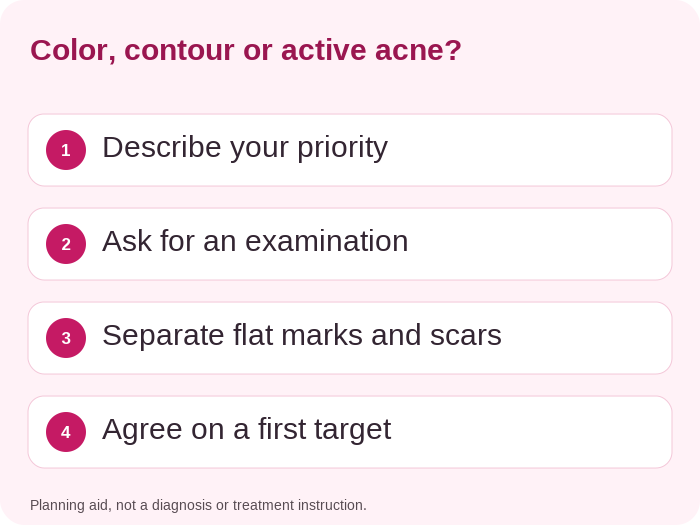
An adult acne consultation should establish whether the eruption is acne, assess severity and scarring risk, and review previous treatments and medical history. Ask for a course you can continue after travel, including prescription monitoring and a review point. Separate active acne management from later scar procedures so each has a clear purpose and budget.
A useful appointment starts before you choose a procedure
An adult acne consultation in Seoul should leave you with an explanation of your breakouts, a manageable treatment plan and a way to review progress after you return home. It need not end with a procedure. If your main frustration is that spots keep returning, the most useful question is what will reduce new breakouts over time, rather than which appointment produces the smoothest appearance that afternoon.
Write down your priorities before browsing menus. You might want fewer painful spots, less irritation from treatment, help with persistent marks, or a plan that fits pregnancy intentions. Put these in order. That gives the clinician a practical starting point and helps you recognize when a proposed package is addressing a different problem. This guide focuses on organizing that conversation; individual medicines and scar procedures have their own guides.
Tell the story of the breakouts, not just the worst photograph
Acne can continue from adolescence or begin during adulthood. Hormonal changes, some medicines and skin or hair products can contribute, but a location such as the jawline does not by itself establish a hormonal diagnosis. The American Academy of Dermatology's adult acne guidance supports discussing these possibilities with a clinician rather than deciding the cause from a social-media face map.
Prepare a brief timeline: when the current pattern began, which areas are involved and whether lesions are mostly small bumps, inflamed spots or deeper painful lumps. Include the chest or back if relevant. Mention a new rash that feels unlike your usual acne, and bring photographs from different stages. One calm day in the clinic should not erase the history of a difficult month. Explain sleep disruption, discomfort or avoidance of social situations too; these are useful measures of how much the problem affects you.
Read the evidence: AAD: Adult acne
Make a treatment history that a doctor can actually use
A list saying that you have tried everything is understandable, but difficult to act on. A more informative record gives each product or medicine, roughly how long you used it, how consistently, what improved and why you stopped. Photograph ingredient labels if the packaging is in a language you cannot easily translate. Include prescribed creams, oral treatments, spot treatments, exfoliating products and clinic procedures.
Distinguish failure from intolerance or interrupted use. A product abandoned after severe irritation raises a different question from one used as directed without sufficient improvement. You do not need perfect dates or a beautifully formatted spreadsheet. A few accurate notes are enough to show the sequence. If several products started together, say so rather than guessing which caused a reaction. Do not stop an unrelated prescribed medicine because you suspect it contributes to acne; raise that concern with its prescriber.
Read the evidence: AAD: Adult acne
Discuss hormonal symptoms and pregnancy intentions directly
A consultation should leave room for relevant menstrual changes, pregnancy plans, breastfeeding, other health conditions and all medicines or supplements. These details can affect treatment choices. Bring them up before a prescription is finalized, even if you booked what the clinic calls a cosmetic appointment. A photograph cannot communicate information about pregnancy intentions or interactions.
Ask whether your history suggests a need for further evaluation rather than requesting a particular hormone test or medicine based solely on the position of your spots. Not every adult with acne needs the same investigation. If hormonal treatment is proposed, ask why it fits your circumstances, what alternatives exist and who will supervise it later. If you prefer not to discuss sensitive details through a booking coordinator, ask how to share them privately with the treating clinician. The goal is an informed medical conversation, not a self-diagnosis before arrival.
Read the evidence: AAD: Adult acne treatment · AAD: Updated acne guidelines
Separate medical acne care from an extraction appointment
The AAD's updated acne guideline describes several topical and oral treatment approaches. Selection depends on the clinical findings, previous response and individual circumstances. It also notes insufficient evidence to make recommendations for several procedural approaches to acne, including certain laser, light and peel treatments. That is a reason to ask what a proposed procedure contributes, rather than assuming a technology-focused menu offers an equivalent substitute for medical care.
For each item, ask which lesions it targets and how its effect will be assessed. If an extraction or facial is suggested, what addresses the breakouts that appear next month? If a prescription is suggested, what should happen if it irritates your skin? You may reasonably choose a medical consultation without purchasing a procedure. Conversely, a selected procedure may have a role within an explained plan. The distinction is whether each component has a purpose you understand.
Read the evidence: AAD: Updated acne guidelines
Leave with a routine you can follow on ordinary days
Ask the clinician to turn the recommendation into a written routine using active ingredient names, not only brand names. Clarify what belongs in the morning, what belongs in the evening and how to respond to irritation. The instructions should specify which existing products remain useful and which duplicate or complicate the plan. Do not independently layer several unfamiliar actives to make progress faster.
Test the practicality of the plan out loud. Can you obtain the products after returning home? Does the schedule fit shift work or frequent travel? Are there instructions you cannot read? If cost makes one part difficult to maintain, say so before leaving. A simpler plan that you can follow and review is more useful than an elaborate set of products whose roles are unclear. Keep the written instructions with the labels so a later clinician can understand exactly what you used.
Agree on a review point before judging success
Acne improvement usually needs time, and the useful observation period is longer than the immediate appearance after a facial. Ask when your clinician expects to reassess the chosen plan and what changes should be recorded before then. The AAD's adult acne treatment advice emphasizes patience and dermatology assessment for persistent, deep or scarring acne; it does not promise a complete course during a holiday.
Choose measures that reflect your own starting problem: fewer new painful lesions, less disruption, a routine you tolerate, or fewer new marks. Keep old pigmentation separate from the number of new spots. Otherwise a useful reduction in breakouts may be obscured by marks that are still visible. At review, ask whether partial improvement calls for adjustment, more observation or a different approach. Do not silently continue an intolerable regimen until a distant appointment; obtain advice about a suspected adverse reaction.
Read the evidence: AAD: Adult acne treatment
Make the first Korea visit useful even when it is short
A brief stay can support assessment, documentation and a plan for continuing care. It cannot compress every treatment course into the days between arrival and departure. Tell the clinic your dates before accepting a plan and ask which decisions require an in-person review. Reserve time to understand the instructions instead of placing the appointment immediately before the airport transfer.
If a new systemic medicine is discussed, establish who can prescribe and monitor it after you leave. Isotretinoin in particular requires a separate discussion of suitability, serious pregnancy risks and follow-up; our dedicated guide explains the questions to raise. Do not assume a Korean prescription can automatically be renewed abroad. If continuity is uncertain, it may be more practical to complete the consultation in Seoul and discuss the proposed course with your usual clinician before starting it.
Read the evidence: AAD: Isotretinoin safety · CDC: Medical tourism
Keep active acne, marks and scars in separate parts of the plan
A flat brown mark, a red residual spot and an indentation are not interchangeable findings. Ask the doctor to identify which are present and distinguish them from active lesions. This helps keep a scar package from absorbing the budget intended to control ongoing breakouts. A plan may have several goals, but they should be named separately.
Request two written decisions: what to do about current acne, and when to reconsider residual marks or texture. The second decision may depend on the first response. If a scar procedure is offered immediately, ask why that timing makes sense in your case and whether a later reassessment could change the recommendation. Photograph the baseline under consistent conditions so changes can be compared fairly. You do not have to commit to every later stage during the first consultation in order to benefit from a clear initial plan.
Compare complete costs and arrange a handover
Ask for consultation, medicines, any indicated tests, procedures and follow-up to appear as separate items. Check whether a quoted review includes speaking to the doctor or only a brief administrative check. If you receive a package price, ask which components are optional and what happens if the medical plan changes. No universal price describes a course that has not yet been selected for you.
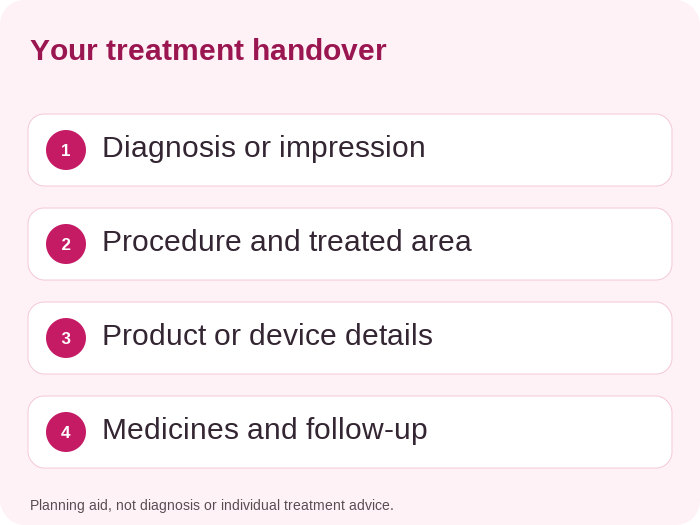
Before departure, request the diagnosis, generic medication names, instructions, relevant results and the planned review point. Confirm how a clinical question will reach a qualified professional and whether remote review is available for your location. If it is not, identify an appropriate local clinician at home. Keep medicines in their labeled packaging and check the requirements for the countries on your own route. A documented handover makes the second appointment more useful, whichever country it happens in.
A relevant clinic and doctor to explore
Delight Dermatology Clinic is a listed option to investigate for an adult acne consultation. Its international website lists acne and redness care; its biography of Dr. Yun Sang Youl identifies him as a dermatology specialist and includes acne among his areas of practice. These published details support considering a consultation, without establishing that any particular treatment is right for you.
Read the clinic and doctor profiles below, then use the international website to ask about an appointment focused on recurrent adult breakouts. Specify that you want a medical assessment, bring your treatment history and confirm language arrangements and the clinician you will see. The selection here is based on the published relevance of the service and named physician, not a ranking of outcomes. Ask how continuing prescriptions and review would work once you are home.
Read the evidence: Delight: International clinic website · Delight: Dr. Yun Sang Youl biography
Bring a medication history that a Korean clinician can use
List the generic names, doses, dates and response to acne treatments used in the United States, including prescriptions that were stopped because of side effects. Tell the clinic whether you want a second opinion, management of active acne or treatment of scars. These goals can lead to different appointments. Before starting a new long-term plan, identify who will prescribe and review it after you return. Ask for an English assessment summary to share with your usual clinician rather than expecting a skincare shopping list to provide continuity of care.
If the consultation turns to hormonal acne treatment
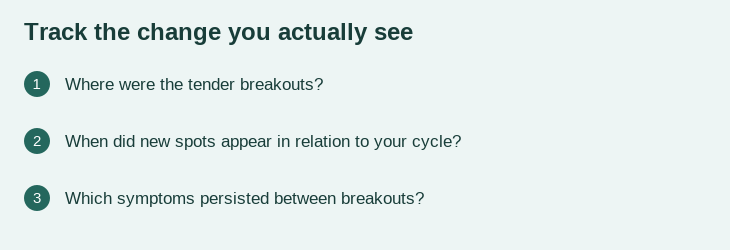
Bring a description of what actually happens across a month. “I notice tender bumps along my jaw during the week before bleeding starts” is more useful than deciding on your own that a hormone level is abnormal. If periods are irregular, pregnancy is possible or your contraception recently changed, mention that privately. A clinician can decide whether the pattern needs additional assessment. Where a breakout appears does not establish its cause.
Ask the prescriber to explain the choice of treatment in terms of your own health history. Oral contraceptives and spironolactone are options for some patients, and their precautions differ. A clinician needs to review other medicines and pregnancy intentions. Do not borrow someone else’s tablets or change contraception in preparation for a cosmetic appointment. If monitoring or a prescription renewal will be needed after you fly back, settle who will provide it before starting.
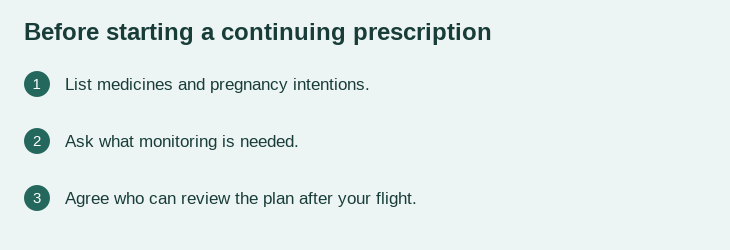
One concrete question is: “If I am home in the US when the next review is due, what will the clinician there need from you?” Request the generic medicine name, reason for the recommendation, relevant monitoring plan and a record of alternatives discussed. If no continuing prescriber is available, ask whether an examination and written opinion in Seoul, followed by treatment nearer home, better fits the trip.
Hairline bumps after a change in styling products
Take the distribution of the bumps seriously. If the middle of the forehead has stayed clear while small bumps cluster at the hairline and temples, think back to what has been touching those areas. A new leave-in conditioner, styling wax, or oil on the edge of a head wrap may be more informative to your dermatologist than the brand of cleanser you bought after the breakout began. Products that leave oily residue can contribute to acne. The pattern alone cannot establish the cause.
Put the start date of each hair product beside the date of the first bumps. Take a photo of its US ingredient label and one unfiltered photo showing where the hair rests against the skin. Mention contact through a pillowcase, hat, or sports headband if that fits your routine. Ask the dermatologist whether a trial of a different styling product and a follow-up at home would be more useful than purchasing an extraction session in Seoul. Agree what would count as improvement, such as fewer new bumps at the hairline. The brown marks left by old bumps can remain even as the underlying acne improves.
Sources and clinical guidance · aad.org · Clinic profile · Official international consultation
Patient questions
Can one appointment cure adult acne?
One appointment can establish a diagnosis and plan, but ongoing acne often needs treatment and review over time. Ask what the first visit can realistically accomplish and who will assess the response.
Should I stop every product before the consultation?
Ask the clinic for preparation advice for your appointment. Bring the actual product list and do not independently stop prescribed medicines or create a new routine simply to make the consultation easier.
What if I tried a medicine before?
Record how long you used it, what improved, whether it irritated your skin and why you stopped. This helps distinguish inadequate response from intolerance or interrupted use.
Can I book only a medical consultation?
Ask the clinic whether a consultation without an immediate procedure is available and what it costs. A useful assessment should allow you to consider the recommendation before committing to optional treatments.