What treatment records should I take home?
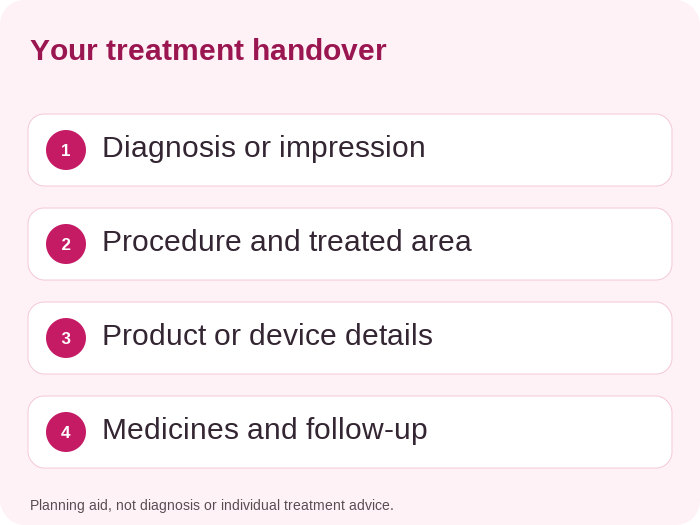
Ask for a legible account of the diagnosis or working impression, procedure and date, product or device details when available, medicines, aftercare and follow-up contacts. Keep uncertainty visible and seek urgent care without waiting for paperwork.
The record that follows you home
A receipt or a photograph of a promotional package is not a complete treatment record. Before leaving a Korean skin clinic, ask for a legible account of what was assessed, what was actually performed, and what should happen next. The most useful set contains the date, clinic and treating clinician, the diagnosis or clinical impression, treatment areas, exact procedure names, product or device details where relevant, medicines, aftercare and follow-up arrangements. If the diagnosis is uncertain, keep that uncertainty visible instead of turning a possible explanation into a confirmed diagnosis. Ask for the clinical summary in a language you understand if the clinic can provide one; retain the original names as well. Availability, preparation time and any fee for copies or translation should be confirmed directly. A written plan is useful even if recovery is uneventful: another clinician may need the details months later when advising on medication, examining a new symptom or considering a future procedure. The CDC advises medical travelers to obtain overseas records and arrange continuity of care before returning home.
Read the evidence: CDC: medical tourism · CDC: medical records and follow-up
Before the visit: make an incoming history
A useful outgoing record begins with an accurate incoming history. Bring a list of prescribed and non-prescribed medicines, active skincare products, allergies and previous reactions. Include generic names, strengths and directions where you know them; photographs of packaging can supplement, but not replace, a readable list. Note previous procedures, approximate dates and locations, including injectables or energy treatments, even if you no longer see an effect. If a product or exact date is unknown, write “unknown” rather than guessing. Tell the clinician about important medical conditions and relevant pregnancy or breastfeeding considerations so they can decide what information matters. Bring prior biopsy, laboratory or specialist reports if related to the reason for the appointment. A short timeline describing the onset of a rash, pigment change or scar, together with previous diagnoses and responses to treatment, often explains more than a catalogue of products alone. Ask what information the clinic would like sent securely before the appointment and what should be brought in person.
Read the evidence: CDC: medical records and follow-up
What was assessed and decided?
Request the diagnosis or working impression, the reason the treatment was considered, and any important uncertainty. A finding described as “possibly melasma” should not become “confirmed melasma” in your own notes. Ask whether a new or changing lesion needs a medical examination or testing before an elective cosmetic procedure. Keep relevant investigation and pathology reports when performed, including the date and the responsible service. Record the clinician’s name and role as written on the documents, rather than assuming that the person providing a consultation is the person who performed every treatment. A clear summary may also identify the goals you discussed, any alternatives or decision to defer, and the follow-up proposed. If the recommendation changed after examination, keep both the final plan and the explanation for the change. This is especially helpful when another clinician later needs to understand why a treatment was chosen. It does not replace a future in-person assessment or guarantee that a later clinician will reach the same conclusion.
Record the treatment, not just the package
Ask for each procedure separately: its date, the body or facial areas treated, the name used in the clinical record, and the person or team responsible. For a device-based treatment, request the manufacturer and model, the type of device and the relevant settings or parameters that the clinic is willing and able to provide. Ask the clinician to explain what those terms mean; a settings list alone cannot tell a patient whether a future session is safe. For a peel or topical procedure, record the product, concentration if documented, treated areas and any other information the provider considers relevant. If more than one treatment was performed, write the sequence rather than combining everything under a marketing label. Keep the plan for any planned repeat session, but do not assume the same settings should be copied by a different clinician or used on changed skin. Skin response, diagnosis, device calibration and examination matter. If a specific detail is unavailable, mark it as missing and keep the clinic’s record-request contact.
Injectables and product details
If an injectable was used, ask for the exact product or brand, manufacturer, treated sites and documented quantity or dose. When available, request the batch or lot number and any identification sticker supplied for the product. For fillers, keep the product name and the location and date of treatment; a future clinician needs to know if a previous material or treatment may be relevant to an assessment. Toxin products and their units are not interchangeable, so preserve the product name together with any recorded number instead of treating the number as a universal dose. Ask whether a diagram or written treatment map is available and what it accurately shows. Do not infer an ingredient from a translation, a syringe photograph or a similar-sounding brand. If the clinic corrects a detail later, keep the correction with its date rather than silently replacing the original. Product and device documentation helps with continuity and traceability, but it cannot establish authenticity or safety on its own. For a suspected serious reaction, seek care first rather than spending time reconstructing paperwork.
Prescriptions, instructions and the first few days
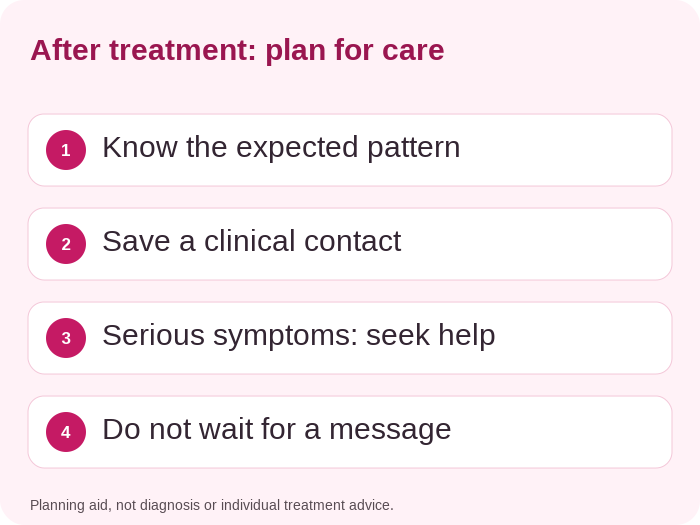
Take home the written aftercare plan, any prescription or dispensing label, and a list of medicines or products that the treating clinician advised you to use or avoid. Where possible, retain the generic name, strength, form, instructions and intended duration. Check that you understand the timing and which part of the body each instruction applies to. If the plan differs for different treated areas, ask the clinic to separate them in writing. Ask how to contact the responsible team, expected response hours, whether messages can be answered after you return home, and where to seek urgent local help if they cannot respond. Save follow-up appointments and the name of the person or service responsible for arranging them. If a treatment plan changes by phone or message, write down the date, who gave the advice and what changed, then ask for written confirmation when practical. Do not start, stop or extend a prescription solely because a travel article describes another person’s routine. Ask your own clinician or pharmacist about your situation.
Photographs and a dated recovery timeline
If the clinic takes baseline or follow-up photographs, ask how you may obtain copies and whether the dates and treated areas can be identified. Keep your own images in reasonably consistent lighting and angles when useful, and label the date without altering the image to exaggerate or minimize a change. A photograph is context, not a diagnosis: a camera can change how color and swelling appear, and skin tones can be represented differently across devices. Alongside photographs, write a short timeline of symptoms, medicines and advice, distinguishing your observation from a diagnosis a clinician has made. If you develop a concern, note when it began, whether it is changing and what treatment was recently performed. Ask the clinician which details or images are useful when you request advice. Do not wait to obtain perfect pictures or translated documents if you need urgent assessment. A nearby qualified clinician can assess you while the records are being requested, and the original clinic can be contacted afterward when safe.
Translation, privacy and sharing
Ask what languages the clinic can provide for a clinical summary and aftercare sheet, and confirm who can clarify a translated term. Keep the original record alongside any translation, especially exact medication, product and device names. A professional translation may be useful for complex or disputed information; machine translation can help identify questions but may misunderstand dosages, negation or treatment names. Ask a qualified person to resolve uncertain instructions before relying on them. You control what you share with future care teams: use a secure channel recommended by the receiving clinician when available, check the recipient and share only what is needed. Photographs can identify you, and cloud links or messaging apps may expose records if sent to the wrong person. Ask the clinic separately how treatment photographs will be stored and whether they are requesting permission for use in advertising or social media. Permission for clinical documentation should not be casually assumed to mean permission for promotion. Access procedures and privacy rules vary by provider and jurisdiction; ask the clinic about its process rather than assuming a particular legal entitlement or turnaround time.
If something is missing or changes after you leave
Contact the clinic’s medical-records or international-patient team with the treatment date, your identifying details through its approved channel, the clinician or department if known, and a concise list of the missing items. Ask whether a summary, treatment note, product information, aftercare sheet or referral letter can be provided and when. Confirm any identification requirements, translation limits and fees directly before sending sensitive information. If the appointment included more than one provider, you may need records from more than one source. Save the request and response dates. If you have moved on to another country, ask your local clinician what information would most help them; a brief clinical question may be easier for the treating clinic to answer than a request for every internal record. If the name or amount of a product remains unknown, disclose that uncertainty to the next clinician. Never fill a gap by copying a device setting from an online review. As symptoms or treatments change, add dated entries and keep both old and updated versions, so that the sequence remains clear.
Read the evidence: CDC: medical tourism
Choose a suitable consultation and plan handover
Korean Skin Clinics lists BLS Clinic Main Branch in Cheongdam. The clinic’s English international website presents laser and skin-care treatment categories. If those services match your concern, you can review its official international information and ask its team whether it can evaluate your particular problem, who will perform any proposed procedure, and what written records and follow-up arrangements are available. A listed service does not establish that a treatment is suitable for you, that a particular clinician is available, or that every record can be translated. The clinic profile on this platform provides another starting point for checking its identity; confirm appointment and language arrangements directly. For an unresolved medical diagnosis or changing lesion, a medical dermatology assessment may be more appropriate than choosing a cosmetic package. Before a first visit, ask whether relevant records can be sent securely, whether an interpreter can help explain consent and aftercare, and who to contact after leaving Korea. Keep a local follow-up option at home in case symptoms arise outside the Korean clinic’s response hours.
When records should not delay care
A tidy folder is valuable, but it is not an emergency service. If you feel seriously unwell or have a rapidly worsening problem after a procedure, seek urgent local medical assessment rather than waiting for an overseas reply or a translation. For an immediately life-threatening problem such as difficulty breathing or collapse, contact local emergency services. Tell the assessing team about recent procedures, prescribed and non-prescribed medicines, the date and where treatment was received; provide the documents you already have and explain what is missing. Follow the treating clinician’s individualized instructions and ask them which symptoms require urgent or routine review for your particular procedure. When the immediate situation is safe, request any missing note or product detail from the original clinic and send it to the clinician coordinating follow-up. Practical continuity means having both a plan for ordinary questions and a route to timely in-person care when a message or photograph is not sufficient.
Request a handoff your U.S. clinician can interpret
Ask for an English summary containing the diagnosis, date, clinician, treated sites, device and settings when available, and exact injectable or medication details. For an injection, request the product name, amount and batch information when recorded; for testing, obtain the report and the result-review plan. Use dates with the month spelled out to avoid confusing U.S. and other date formats. Keep original records as well as translations and share them through the receiving clinician's secure process. Confirm who will answer a clinical question about the record after you return, without sending health information through public website search fields.
Read the evidence: CDC Yellow Book: records after medical care abroad
Patient questions
Do I need a record if treatment went smoothly?
A record can help another clinician understand what was done even when the initial recovery is uneventful.
Should I wait for a translation during an emergency?
No. Seek urgent local care first and share the details you already have.