When should I seek help after a skin procedure?
Follow the instructions for your own treatment. Get urgent local assessment for serious or rapidly worsening symptoms. Breathing difficulty, collapse, or sudden vision changes require immediate emergency help; do not wait for an online reply.
Start with the procedure you actually received
After a skin treatment in Korea, the safest recovery plan is the one written for the exact procedure, treatment area and your medical circumstances. Laser resurfacing, a light treatment, a superficial peel, microneedling and an injectable do not cause the same injury or need interchangeable aftercare. Even treatments marketed under one device name can differ in settings, area and intensity. Ask the treating clinician for the procedure name, the reason it was selected, and what your skin should look and feel like as it heals. If several procedures were combined, ask which instructions take priority and whether the combined plan changes the expected recovery period.
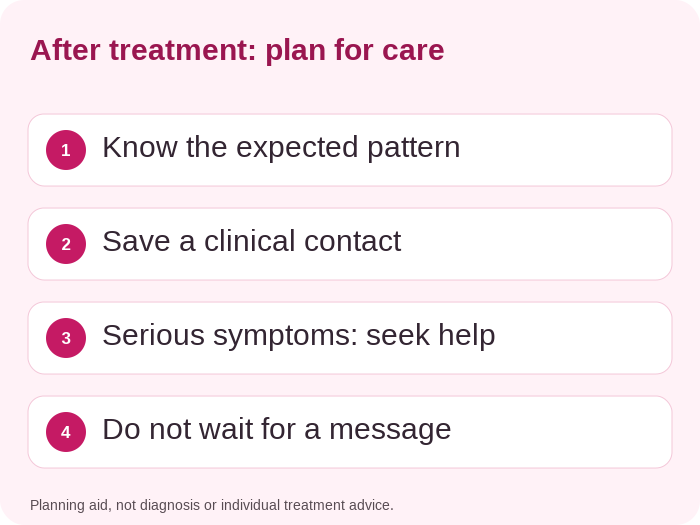
A certain amount of warmth, redness, tenderness, swelling, dryness or bruising can occur after some procedures, but an online list cannot establish that your own reaction is normal. Ask what changes are expected for you, how they should develop and when the clinic wants an update. The direction and speed of change matter: a new or worsening problem deserves attention even if a milder version was mentioned in a brochure. If you are worried, contact the treating team; if a serious warning sign is present, seek urgent local medical care instead of waiting for a message.
Read the evidence: Leeds NHS: laser treatment
Before leaving the room: make a written plan
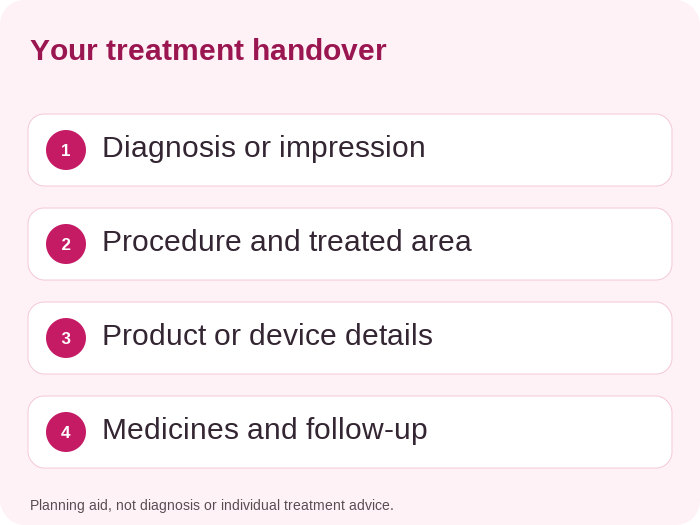
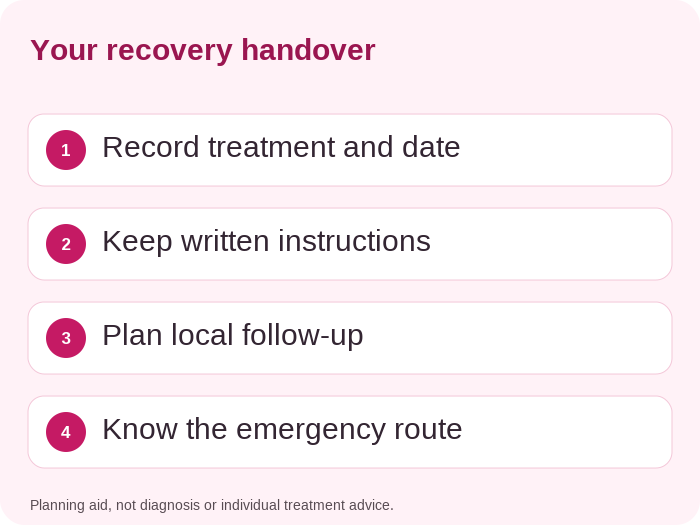
A short discussion before departure can prevent a confusing decision later in a hotel or at the airport. Ask the clinic to write down the treatment name, areas treated, date, relevant product or device details, any medicines administered, and the instructions that apply to you. For an injectable, ask for the product name and batch or lot information if available. Keep the document and contact details somewhere accessible offline as well as on your phone. A photograph of the written plan may help if you lose the paper copy.
Clarify how to contact the clinic during and outside working hours, what response time to expect, and where to seek urgent assessment if you cannot reach them. If interpretation was used for your consultation, ask for written instructions in a language you understand or arrange a reliable translation. Read the instructions back to the clinician: for example, “I should use this cleanser when, and whom should I contact if pain is worsening?” This gives you an opportunity to correct a misunderstanding. Make a follow-up appointment when your clinician recommends one and do not assume a remote photograph can replace an in-person examination.
Expected changes vary: watch the pattern
Ask the clinician what temporary effects are common after your particular treatment and which changes are not expected. Some light or laser treatments can leave the area warm, tender or red; a procedure may also cause temporary swelling or bruising. Stronger resurfacing may create a different healing process from a gentler treatment. Examples from one hospital leaflet do not set a universal number of days for all devices or patients. Skin tone can affect how redness looks: increasing warmth, tenderness, swelling or a change in color can be easier to notice than redness alone. A photograph in similar lighting, taken with your own phone for your treating team, can help explain a change, but it cannot rule out a complication.
Seek timely professional advice if the area is becoming more painful, swelling is increasing, there is new blistering, crusting or discharge, or the course is different from the plan you were given. A painful, hot blister with yellow or green fluid, for example, needs assessment. If you feel systemically unwell, symptoms are progressing quickly, or there is extensive injury, seek urgent local care rather than waiting for routine contact. Do not pop a blister, pick a crust or apply an unfamiliar product in an attempt to force healing.
Know the emergency signs
Call local emergency services or go to the nearest emergency department immediately for breathing difficulty, throat or tongue swelling, fainting, collapse, or rapidly worsening symptoms suggesting a severe allergic reaction. If you have a prescribed adrenaline auto-injector for a suspected severe allergic reaction, use it as instructed in your emergency plan while arranging emergency help. These signs can become dangerous quickly; do not wait for an online reply or travel back to your original clinic first. An allergic reaction does not always look the same in every person, and a rash is not required for a serious reaction.
During or shortly after a facial filler injection, sudden vision change, stroke-like symptoms such as facial droop or difficulty speaking, unusual or severe pain, or a white, dusky or otherwise unusual skin color change can signal a serious complication. Seek immediate emergency medical assessment and inform the injector immediately, without allowing the call to delay emergency care. Sudden loss of vision or severe worsening eye pain after a procedure near the eye also requires immediate emergency eye or emergency-department assessment. The emergency team needs to know what was injected or performed and when. These examples are not a complete list; if a reaction feels severe or you are rapidly deteriorating, seek urgent help.
Read the evidence: FDA: dermal filler safety · NHS: anaphylaxis
Cleanse, protect and avoid friction
Follow the clinician’s exact cleansing and dressing instructions, including how often to clean the area, what to use and whether it should be covered. Wash your hands before touching treated skin. Avoid picking flakes, crusts or scabs; tearing healing tissue can cause injury and may affect the final appearance. Do not scrub the skin, share towels, or try to drain a blister or a suspected infection yourself. If you are given a prescribed medicine, ask how to use it, what it is for, and what to do if it irritates your skin. Do not stop an unrelated prescribed medicine or start antibiotics, steroid creams, antiseptics or other treatments solely because a social-media post recommends them.
Ask when it is safe to resume make-up, shaving, exfoliants, retinoids, acids, fragranced products and your usual skin-care routine. Timing is procedure-specific: for instance, one laser aftercare protocol can advise a pause in products that another procedure does not require. Using a complicated new routine immediately after treatment can make irritation harder to interpret. If your written instructions conflict with a product label or something you read online, clarify the conflict with your treating clinician rather than guessing. If you are unable to reach the team and the problem is urgent, seek local medical assessment.
Sun, heat and activities during your trip
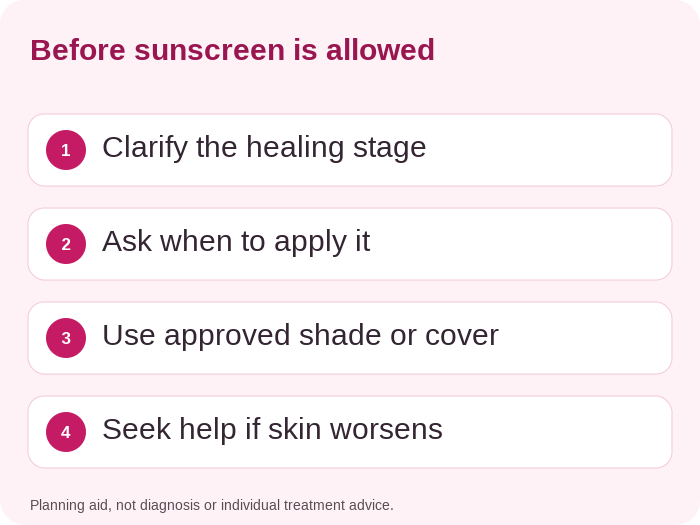
Skin may be particularly vulnerable to sun after certain light, laser or resurfacing procedures. Before treatment, ask about the duration and type of sun protection that applies to your procedure, when sunscreen can be applied to the treated area, and how to protect skin if it is still open or irritated. Shade, protective clothing and a hat can help limit direct exposure. Where the treating clinician says sunscreen is appropriate, use the product and reapplication approach they recommend. Sun protection is relevant during sightseeing, walking between stations, outdoor queues and onward travel, not only at the beach.
Heat and friction may also matter. Ask when you can return to exercise, swimming, a sauna or jjimjilbang, hot baths and activities that make you sweat heavily. Do not assume that a restriction in another patient’s leaflet applies to you, or that the absence of visible peeling means your skin is ready. A lighter schedule gives you room to follow wound care and attend a review if one becomes necessary. If you have an important event, tell the clinician before treatment: visible redness, swelling, bruising or peeling may last longer than you expect, and cosmetic products may not be appropriate immediately.
Read the evidence: Leeds NHS: laser treatment
Before a flight or the next procedure
Share your departure date and planned flight before agreeing to treatment, especially if the procedure may leave open skin, considerable swelling or a need for an early review. Ask whether the clinician recommends an in-person check before departure, what would make travel inadvisable, and how to obtain care if your symptoms change en route. There is no reliable rule that every patient can fly the next day or must stay a fixed number of days. The appropriate interval depends on the treatment, recovery and your broader health. A full itinerary that leaves no opportunity for a check can make it harder to respond when recovery differs from the plan.
If another clinic, salon, spa or dentist will see you during the trip, tell them what was done. Ask the clinician when other procedures, massage or devices may safely be considered. Combining procedures can increase the difficulty of identifying which treatment caused a reaction and who is responsible for follow-up. Avoid arranging another intervention over irritated or healing skin without advice. Keep receipts and the treatment record; confirm what assistance is included in the price, who provides it, and whether care after you leave Korea would be billed separately. Insurance coverage varies, so ask your insurer about exclusions and emergency-care procedures before travel.
How to get help after you leave Korea
Save the clinic’s international contact details, but identify a local medical option at your destination as well. If symptoms need same-day or urgent assessment, contact an appropriate local clinician or urgent care service instead of relying on a delayed message across time zones. For an emergency, use the emergency number and emergency services in the country where you are physically located. If you are in South Korea and require an ambulance, the national emergency number is 119; if you are elsewhere, use that country’s local number. Tell the clinician that the problem followed a skin procedure and bring your treatment record, medication list, allergies and any before-and-after photographs you are comfortable sharing.
A useful message to a clinic includes the treatment date, product or device if known, area, symptom onset, whether symptoms are worsening and any fever or other symptoms. Ask whether they recommend an immediate local examination. Do not send sensitive photographs through an unfamiliar channel without checking the recipient and how the clinic handles them. Remote advice may help coordinate information but cannot assess every complication. If your planned follow-up becomes impossible because you have already left, ask a local clinician how to obtain the records needed to continue care; do not postpone urgent treatment while waiting for a translation or a reply.
Read the evidence: CDC: medical tourism · Seoul government: emergency services
Questions to ask and a relevant clinic
Before proceeding, ask: What reaction is expected for my treatment and skin? Which symptoms require an immediate call, same-day assessment or emergency care? When may I wash, wear make-up, exercise, swim and return to active skincare? How do I protect the area outdoors, and what should I do if sunscreen irritates it? Do I need an early review before my flight? Who answers questions after hours and after I return home? What information can I take to a clinician in my own country? If the answers depend on how the skin responds, ask the team to explain what change should trigger a reassessment.
BLS Clinic Main Branch in Cheongdam is listed on this platform and its international website describes laser services for concerns including pigmentation and scars. It is one relevant place to discuss a proposed laser plan and, before any treatment, ask who supplies written instructions, the expected recovery and the arrangements for review. Its listing does not establish that every procedure is right for you or that a particular follow-up service is guaranteed. Use the links below to review the clinic’s official international laser information and its platform profile. Ask the clinic directly to confirm language support and aftercare availability for your specific appointment.
Frequently asked questions
Is all redness after a laser dangerous? No. Some procedures commonly cause temporary redness or warmth, but expected changes vary. Ask for the expected pattern and seek assessment for symptoms that are severe, unexpectedly worsening or unlike your plan. A photograph is useful context for your doctor, not a diagnosis or a reason to defer urgent care.
Can I use my regular exfoliating serum? Ask first. The clinician may advise pausing exfoliants or other active ingredients while the skin heals. Do not assume that a product you tolerate on uninjured skin will be comfortable immediately after a procedure. If the skin becomes severely swollen, painful or blistered, obtain medical advice rather than simply covering it with cosmetics.
Can I travel the next morning? There is no universal answer. Give your departure time to the clinician before the procedure and agree on whether observation or an in-person check is needed. If urgent symptoms arise, seek local care even if that changes your travel plan.
Can I wait for the clinic to reply if breathing is difficult? No. Breathing difficulty, throat or tongue swelling, collapse or similar severe symptoms call for emergency help immediately. Notify the clinic as well when safe to do so, but do not let that delay emergency care.
Will a clinic be able to follow me after I return home? Some international services describe remote communication, but availability, languages, fees and limitations vary. Confirm what your treating clinic offers, and identify a qualified local clinician for problems that need examination.
Decide where to seek care in Korea and in the United States
Before treatment, ask which symptoms need an immediate in-person assessment and where that assessment would take place. Keep the product names, procedure date and clinician contact details readily available. After returning to the United States, tell any treating clinician that you received care abroad and provide the records; do not delay assessment while waiting for a message from Korea if symptoms are urgent. Ask the Seoul clinic to distinguish routine follow-up from emergency care and clarify whether it offers administrative communication after departure. A messaging contact is not a replacement for a local emergency or clinical service.
Read the evidence: CDC Yellow Book: medical tourism and follow-up
Tell the resurfacing team about a cold sore before or after treatment
When discussing resurfacing around the mouth, mention previous cold sores even if the last one was years ago and the skin looks clear. Laser resurfacing can reactivate herpes simplex. Describe where a previous episode started, whether you felt tingling first, and whether a clinician diagnosed it. Ask whether your planned procedure calls for a preventive prescription and who will review your other medicines. A prescription or schedule from an earlier trip is not a safe substitute for a plan specific to the new procedure. If a fresh blister or unusual tingling starts before your appointment, contact the treating team before attending for treatment.
After resurfacing, tell the clinic promptly about a new cluster of painful blisters, sores or a patch that becomes increasingly painful. Healing skin can look different from an ordinary cold sore. A photograph with the date and a description of the change can help the team triage your call, but a photograph cannot confirm the cause. Ask whether someone needs to examine you that day. If your eye hurts, becomes red or sensitive to light, or your vision changes, seek urgent eye assessment. You can use local care immediately if the clinic is closed or you have already returned home.
A useful handover includes the date, the exact area treated, when symptoms first appeared and any medicines actually taken. Keep the clinic's daytime and out-of-hours contacts on your phone before leaving. If you need care back in the United States, bring those details along with the procedure record. They help the clinician distinguish an expected healing change from an infection and avoid prescribing around an incomplete medication history.
Patient questions
Is some redness always an emergency?
Expected changes differ by procedure. Ask your clinician about the expected pattern; seek timely assessment for severe, unexpected or worsening symptoms.
Can I wait for a message if breathing is difficult?
No. Seek emergency help immediately, and inform the treating team when it is safe to do so.