When can I apply sunscreen after a skin procedure?
Ask your treating clinician when sunscreen can be applied to the treated area. Until then, use the shade and protective covering they recommend; do not assume one timetable fits every procedure.
Start with the treatment, not a universal sunscreen deadline
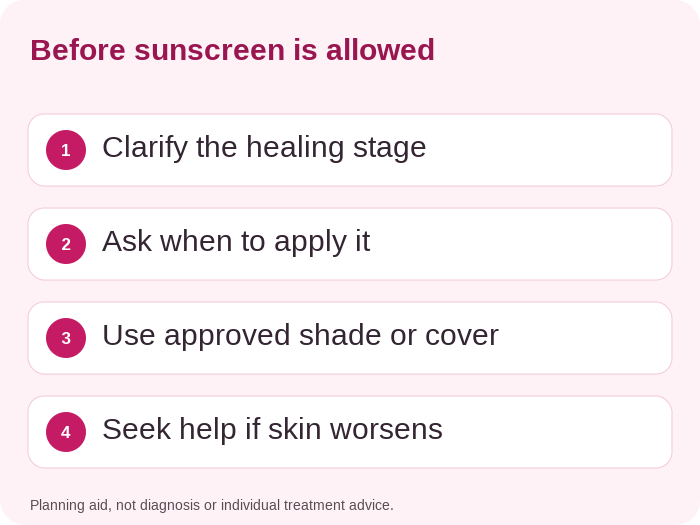
Sun protection after a skin procedure is a plan, not simply a high number on a bottle. A laser, chemical peel, microneedling session or minor surgical procedure may leave skin in very different states. Some patients leave with intact skin and mild redness; others have a dressing or an area that needs time to close. Ask the treating clinician when sunscreen may touch the treated area, what to use until then and when they want to review it. Do not apply sunscreen into an open, raw or dressed area unless your own team has specifically directed you to do so. Until application is permitted, use the physical protection the team recommends, such as appropriate clothing and shade, and avoid direct exposure to the treated area. Avoid rubbing or pressing a covering against a tender area when it conflicts with your instructions.
This distinction matters for an international patient who plans to explore Seoul immediately after treatment. One NHS laser service tells its own patients to delay sunscreen for two days and then use a high-protection product for a defined period. That is an example of a specific service protocol, not a timetable for every device or person. A deeper treatment, your own healing response and your clinician's dressing instructions can change the plan. Before paying for a package, ask for an individualized written schedule that covers the procedure you will actually receive.
Read the evidence: Leeds NHS: after laser treatment
Why light protection matters after treatment
Sun exposure can darken some treated areas and contribute to new or persistent uneven pigmentation. The skin response is not identical for everyone: the procedure's depth, area, previous inflammation, baseline skin tone and tendency to develop post-inflammatory dark marks all matter. Protection is not a promise that discoloration or scarring cannot happen, and a product labelled SPF cannot make deliberate tanning safe. It is one part of a plan that also includes appropriate diagnosis, careful treatment selection, gentle care and follow-up.
Ultraviolet radiation includes UVA and UVB. A broad-spectrum label indicates protection against both under the relevant product standard, while SPF chiefly describes protection against sunburn from UVB. These terms do not make a treated face ready for unrestricted sightseeing. Heat, wind, rubbing from a hat or mask, and products that sting may also complicate comfort. If the plan requires you to avoid a particular activity or exposure, follow it even if a sunscreen label sounds reassuring. The best time to solve these problems is before the procedure rather than in a pharmacy while your skin feels sore.
Choose a product with your clinician
When sunscreen is appropriate for the treated area, the American Academy of Dermatology recommends broad-spectrum, water-resistant protection with SPF 30 or higher for general sun protection. Your clinician may recommend a higher SPF or a different approach for your procedure. Water resistance is not waterproofing: follow the product directions, reapply after sweating or water exposure, and remember that activities such as swimming may themselves be restricted during recovery. A product that is tolerable and easy to reapply is more useful than one you avoid because it stings or leaves an uncomfortable finish.
Discuss known allergies, dermatitis, acne tendency and prior reactions, and bring your usual products or clear photographs of the ingredient lists. Ask whether a fragrance-free formulation is appropriate, whether a mineral formulation would be gentler for you, and whether your usual moisturizer or makeup can be used at all. Mineral and chemical filters are not a reliable way to predict individual tolerance: a product can irritate for reasons other than its UV filter. If any product causes burning or a new rash, stop using it and contact the treating team for an alternative; do not keep layering new products onto skin that is worsening.
Read the evidence: AAD: sunscreen FAQs
Visible light, pigment and deeper skin tones
People of every skin tone need UV protection. People who develop dark marks after inflammation, including many patients with more melanin-rich skin, may also want to discuss visible light. The AAD notes that visible light can worsen hyperpigmentation and melasma, particularly in darker skin tones; a tinted broad-spectrum sunscreen containing iron oxides can add visible-light protection. Look for iron oxides in the ingredient list rather than assuming that any cosmetic tint supplies equivalent protection. A shade that blends comfortably into your own skin may make regular use easier.
Tinted products do not replace shade or protective clothing and are not appropriate to put on raw or newly treated skin before your clinician says it is safe. Do not assume that a product sold in one country uses exactly the same labelling system as one purchased at home. Ask a pharmacist or clinic to help you read the product label, and take a photograph of the box and ingredient list if you may need to replace it later. If you have melasma, ask about an ongoing maintenance plan as well as the procedure: pigment can recur, and it is not necessarily an indication that a treatment failed or a signal to book a stronger laser.
Read the evidence: AAD: melasma self-care
Make reapplication realistic during a Seoul day
Once the treated skin is ready for sunscreen, ask how much product to apply and when to reapply. General AAD advice is to apply before going outdoors and reapply at least every two hours outdoors, and after sweating or swimming. Your own clinic's specific instructions take precedence where they address healing, product selection or activity. Consider a day broken into short journeys: a taxi to a consultation, a walk between buildings, a meal near a window and a return journey can add up. A morning application does not last indefinitely simply because most activities are indoors.
Pack the chosen product in your day bag, check the expiry date and carry a broad-brimmed hat or protective clothing that the clinician says will not rub the treated site. Choose shade and consider moving long outdoor plans to another day. Clouds, cool weather and a short walk do not eliminate exposure. A sunscreen stick, spray or compact may be convenient, but a format is not a guarantee of even coverage. If you cannot apply enough product without friction or pain, do not force it: reduce exposure and ask the clinic for a plan that suits the healing stage.
Read the evidence: AAD: sunscreen FAQs
Before booking: build your schedule around recovery
Tell the clinic your arrival and departure dates, any outdoor tours, exercise plans, family events, work commitments and whether you are traveling alone. Ask whether the consultation and procedure can occur on different days, and whether it is safer to defer treatment if you have a recent tan, active irritation, an undiagnosed changing spot or a history of abnormal reactions. A changing, bleeding or otherwise suspicious lesion needs an appropriate medical assessment; do not assume a cosmetic light treatment is the right first step.
Ask the proposed treatment name, the area and approximate depth, expected recovery variation, common and serious risks, possible alternatives, and whether an in-person review is recommended before departure. Request the name of the treating clinician and a written plan that clearly separates routine aftercare from symptoms requiring an urgent response. A patch test or a low-intensity first approach may be discussed when appropriate, but neither guarantees a complication-free result. If the clinician cannot explain how the proposed treatment fits the amount of time you have, consider consultation only or postponing the procedure.
Keep the plan practical after you leave Korea
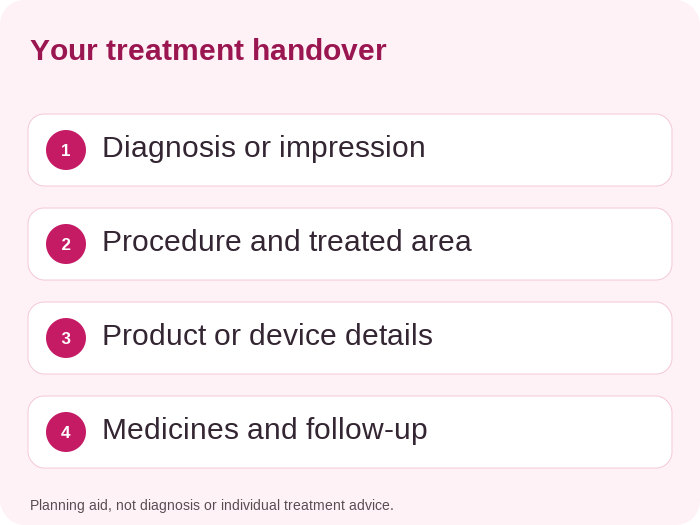
Before you leave the clinic, save a copy of your procedure record, the written instructions, a contact method and the hours when someone can answer. Ask what changes to photograph, which symptoms need a same-day local assessment and which require emergency care. Confirm whether the clinic can help coordinate care after you return home, but do not rely on an overseas reply for urgent symptoms. Your local medical team may need the procedure date, device or treatment name, treated area, medicines used and photographs taken before any complication began.
Bring a simple record of the sunscreen you tolerated and when you were told to restart it. If a product is unavailable in your home country, ask which broad characteristics matter instead of assuming a substitute will be identical. If irritation develops after a change, stop the product and seek advice. Travel insurance conditions, telehealth availability and follow-up arrangements differ; check the terms that apply to you rather than assuming a clinic, airline or insurer will cover every complication. A follow-up plan is part of the decision even if the treatment is described as having little downtime.
When to seek help rather than add more products
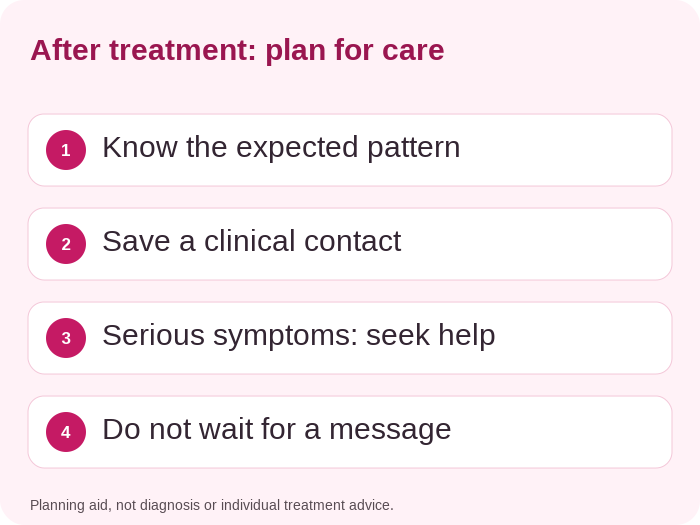
Some redness or temporary sensitivity can be expected after certain procedures, but the provider should explain the pattern and duration expected for your specific treatment. Contact the treating clinician promptly if symptoms are worsening, if pain is increasing rather than settling, or if you develop blisters, weeping, spreading redness, marked swelling, unexpected discharge or fever. These are examples of concerns needing assessment, not a complete list or a diagnosis. Do not cover a concerning change with makeup or experiment with a new active ingredient in the hope that it will disappear.
Seek immediate local emergency care for severe or rapidly worsening symptoms, such as difficulty breathing, collapse, or a rapidly spreading severe reaction. If you cannot reach your Korean clinic and are concerned, obtain local medical care rather than waiting for a message. Once safe, inform the treating team and share the record of what was done. Sun protection is preventive support, not treatment for an infection, burn, allergic reaction or suspicious lesion. An urgent problem deserves assessment on its own terms.
Questions for a clinic and a relevant option
Take a concise list: What procedure and settings are planned, and what type of healing is expected? When exactly may I use sunscreen or makeup on this area? What should I use for shade or covering before then? Which SPF and UVA protection do you recommend, and for how long? If I am prone to pigmentation, is a tinted product with iron oxides suitable once my skin has healed? Which activities, medicines or skincare products should I pause or discuss? When should I contact you, what happens after hours, and how do I obtain care after I return home?
BLS Clinic Main Branch is one listed Seoul option to consider for a consultation about laser and pigmentation concerns. Its official international website lists laser and pigment-related services, making it relevant to a discussion about procedure choice and aftercare; that listing does not establish that a particular device is right for you or that an appointment or language service will be available on your dates. Review the clinic's official international website and the platform profile, describe your skin history and departure date, and confirm your clinician, language support, follow-up arrangements and itemised costs before deciding. A consultation is an opportunity to decide against or postpone a treatment as well as to proceed.
Quick answers for common decisions
Can I rely on SPF if I need to stay in the sun? No. Sunscreen is one layer of protection and must not be used to justify exposure that your clinician told you to avoid. Shade and suitable clothing matter, particularly while a treated area is healing. If a dressing or a raw area prevents sunscreen application, ask for individual guidance rather than trying to improvise.
Does a high SPF mean I never need to reapply? No. A product can wear off through sweat, friction or water. Follow its label and the clinician's plan once sunscreen is safe to use. AAD general guidance recommends reapplication at least every two hours outdoors and after swimming or sweating; your aftercare plan may also restrict these activities.
Can I use a tinted product immediately? Not necessarily. Tint and iron oxides may be useful for some pigment concerns once the skin can tolerate sunscreen, but the timing depends on the treatment and healing. Ask the provider before applying it to the treated site.
What if I only have a few days in Korea? Disclose that at consultation. The safest choice may be a less intensive plan, a consultation without a procedure, or a later treatment at home. Arrange a realistic pathway for review before and after travel rather than assuming that a brief appointment includes all necessary follow-up.
Plan protection from Seoul through your return journey
Ask the treating clinician when sunscreen may be used on the treated skin and what protection is needed before then. Discuss airport transfers, outdoor sightseeing and your work or commute after returning to the United States. Bring the exact sunscreen or protective products you plan to use rather than assuming a new purchase will suit healing skin. Request instructions for reapplication and other measures appropriate to your procedure. If a treatment has specific light-avoidance requirements, ask whether ordinary sun protection is enough instead of treating all post-procedure instructions as interchangeable.
Patient questions
Can sunscreen replace shade?
No. Sunscreen is one part of protection; follow your treatment-specific instructions and use shade and suitable clothing.
Can I use sunscreen on a raw area?
Ask the treating team. Do not apply it to open or dressed skin unless they specifically direct you to do so.