Does persistent facial redness mean I have rosacea?
Not necessarily. Rosacea is one possible explanation for persistent redness, flushing or burning, but other conditions can look similar. A dermatologist should assess symptoms as well as visible color, including eye complaints and changes across skin tones. A management plan may address vessels, inflammation and triggers differently; a redness procedure is not a universal cure.
Start with a goal that includes comfort
If you are considering rosacea treatment in Korea, decide what you most want the consultation to change. You might be troubled by burning during everyday skincare, flushing in meetings, visible vessels beside the nose, or bumps that keep returning. Those concerns are related, but they are not interchangeable. Write down your first priority and one secondary priority before looking at procedure menus.
This makes the consultation more useful. Instead of asking for the strongest redness laser, you can ask which part of your experience a proposed treatment is likely to address. Ask the doctor to explain what success would look like for that feature, how response will be recorded, and what would prompt a change in the plan. A comfortable face and fewer disruptive flares may matter more to you than achieving a particular photograph.
What a rosacea assessment should establish
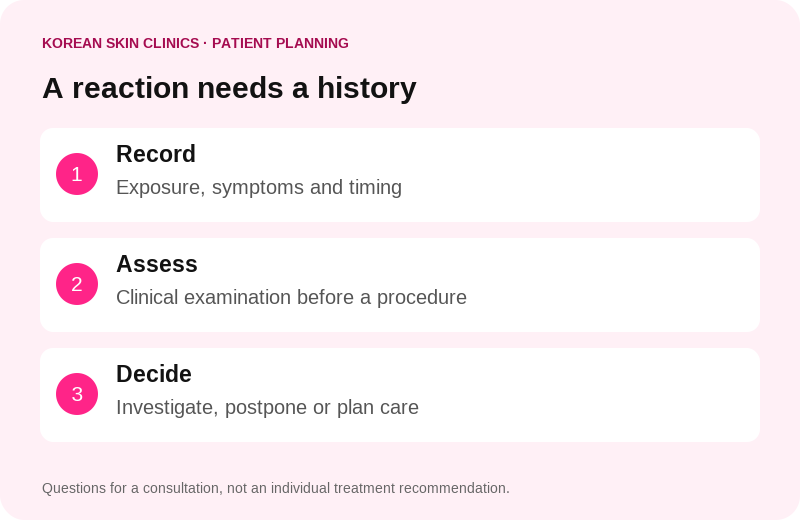
Rosacea is diagnosed through a clinical assessment rather than a single universal screening test. A dermatologist considers the history and examines the skin and eyes; further investigation may be needed when another condition could explain the findings. A cosmetic photograph or automated skin score should not replace that discussion.
Ask the clinician to describe the working diagnosis in ordinary language. If there are several possibilities, ask what information would distinguish them and whether an elective procedure should wait. Bring the names of previous diagnoses and treatments, including anything prescribed at home. This allows the doctor to build on your history rather than treating the visit as an isolated facial service. You can request a written summary of the assessment even when no procedure takes place.
Read the evidence: AAD: diagnosis and treatment
Skin tone changes how the conversation begins
Rosacea can affect people with darker skin, and visible redness may be less obvious or mistaken for another problem. Tell the doctor about heat, stinging and tenderness even when your face does not look red in a photograph. Do not assume that a clinician can infer the severity of discomfort from color alone.
When discussing light or laser treatment, ask about experience with your skin tone and your history of dark or pale marks after inflammation. Bring examples of previous reactions if you have them. Ask how the clinic will document your baseline appearance without filters or changing camera exposure. For your own progress record, take photographs in similar lighting, but keep a separate symptom note. The photograph and the symptom history answer different questions, and both deserve attention at follow-up.
Read the evidence: AAD: rosacea in darker skin
Compare treatment plans by target, not by device count
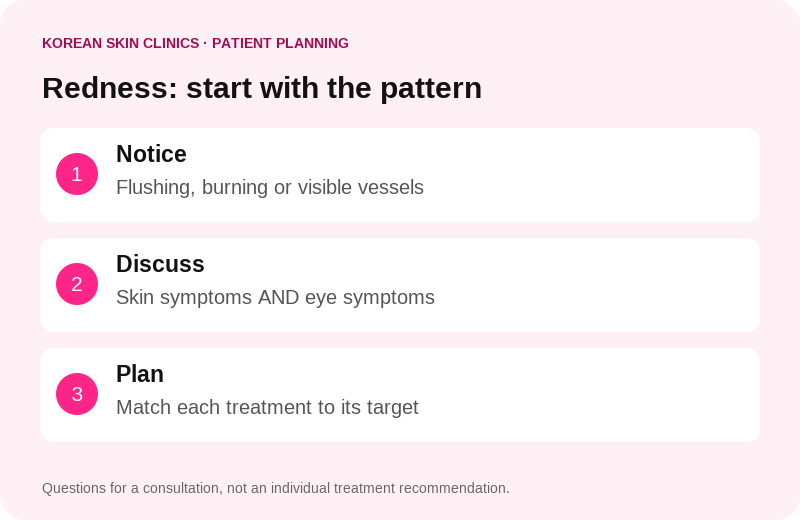
A useful written plan separates everyday management from procedures. Ask the clinic to put each recommendation under a goal: reducing visible vessels, managing inflammatory bumps, supporting comfort, or addressing another diagnosed problem. If several devices are proposed, request an explanation for each one and ask what would be lost by starting with a simpler plan.
Laser or light treatment may be one component of rosacea care. It does not replace all other management, and a device that improves visible vessels should not be described as curing every symptom. The AAD discusses temporary redness and discoloration after treatment, with results and risks affected by the technique and the practitioner. Ask what recovery may look like for the exact procedure offered, whether a test area is appropriate, and how any unexpected reaction will be reviewed before another session is considered.
Read the evidence: AAD: lasers and lights for rosacea
Use your travel itinerary as part of the history
Tell the clinician whether your visit includes outdoor walking, hot environments, long sightseeing days or a special event. Do not ask only whether you can leave the clinic immediately after treatment. Ask whether the planned activities fit the recovery instructions and whether the timing should change. A quieter appointment earlier in the trip may leave more room for review than an appointment immediately before departure, but the appropriate interval depends on the actual treatment.
Triggers differ between people. Keep your own short record rather than banning every food or activity mentioned online. Note what happened, how long symptoms lasted and whether several exposures occurred together. A pattern can be useful without proving that one event caused a flare. Bring the record to the consultation and ask which adjustments are worth trying first.
Read the evidence: AAD: recognizing individual triggers
Keep daily care understandable
A rosacea routine need not be a large shopping list. Gentle cleansing, moisturizing and sun protection are important parts of care. Ask which products you already tolerate can stay, which additions have a clear purpose, and which products should wait. Avoid interpreting tingling as proof that a product is working. If a product repeatedly causes discomfort, discuss it rather than trying to push through the reaction.
Before leaving, ask the team to separate daily products, prescribed medicines and temporary post-procedure products on your instruction sheet. Have them explain when each is used and when to contact the clinic about irritation. If names are unfamiliar, request the generic medicine name and a photograph of the packaging. This helps your clinician or pharmacist at home understand the plan without relying on a translated brand name.
Read the evidence: AAD: rosacea skincare
Know when eye symptoms change the priority
Eye complaints deserve their own discussion. Tell the doctor about gritty or dry eyes, sore eyelids, light sensitivity or changes in vision rather than assuming they are unrelated to your skin. A skin procedure is not a substitute for assessing an eye problem.
The NHS advises urgent assessment for symptoms such as eye pain, blurred vision, light sensitivity, a red eye or a gritty feeling in the eye when rosacea may be involved. Do not wait for a routine cosmetic follow-up if these occur. Seek local medical care, particularly when you are traveling and cannot easily return to the original clinic. Keep the treating clinic informed, but do not make a remote message reply a condition for getting urgent help.
Read the evidence: NHS: rosacea and eye symptoms
Recommended listed clinics for a redness consultation
Maylin Cheongdam is a relevant starting point because its international website has a dedicated Rosacea & Redness Care service. Review that service alongside its Korean Skin Clinics profile, then request a consultation focused on your symptoms and the role of any proposed procedure. Ask what follow-up is available after you return home and whether a medication-based plan or a staged approach may be more suitable than immediate laser treatment.
Delight Dermatology Clinic is another listed option: its international service menu includes Acne & Redness and specifically describes facial redness management. This makes it relevant for an assessment of persistent redness, especially when you also want to discuss inflamed bumps. These suggestions are based on listed services, not a comparative ranking of results. Confirm the clinician who will see you and the current scope of care directly; a service page does not establish that every doctor performs every procedure.
Read the evidence: Maylin: Rosacea & Redness Care · Delight: Acne & Redness
A useful quote includes the review plan
Request an itemized quote after discussing the diagnosis. Separate consultation, procedure, prescriptions, recovery products and review appointments. Ask whether the price assumes a fixed series or allows reassessment after the first session. If a package is offered, clarify what happens when your skin needs more time or the clinician advises stopping.
Before paying, write down the goal in your own words and ask the clinician to confirm it. A good plan should make sense even without a promotional discount: you know what is being treated, what may remain, what care continues at home and who will review the outcome. Keep a copy of that plan with your treatment record so that later decisions reflect your own response rather than the original sales timetable.
Redness has more than one explanation
Persistent redness, flushing and sensitive-feeling skin do not automatically mean the same diagnosis. Rosacea can involve different features, and its appearance can vary across skin tones. A medical evaluation is especially valuable when redness is accompanied by burning, bumps or eye symptoms. Describe what you feel as well as what you see, and explain whether the pattern is constant or comes and goes.
Clarify the treatment target
The AAD describes medication, skincare and selected laser or light treatments as possible components of rosacea management. A device may be intended to address visible vessels or persistent color, while other symptoms require a different plan. Ask which feature the clinician is targeting and which symptoms may remain. An improvement in one feature should not be presented as a cure for every aspect of the condition.
Document your own pattern
Before the visit, note the situations associated with flushing or discomfort, the products that sting and any medications used. You do not need to identify every possible trigger. A short record of your own experience is more useful than following an unnecessarily restrictive list. Bring photographs from flares if your skin is calmer on the consultation day and describe any changes around the eyes.
Build a manageable routine
Ask for a short routine with clear instructions rather than introducing a large number of new products at once. Confirm which products are intended for daily care and which are prescribed treatments. If a procedure is planned, request a separate recovery routine and a restart date for your usual products. Agree on what to do if burning, swelling or irritation is greater than expected.
Plan for ongoing care
Rosacea management may extend beyond one travel visit. Discuss how response will be assessed after you leave, whether a local clinician should continue prescriptions, and what photographs are useful for remote review. Ask the clinic to distinguish expected short-term redness after a procedure from signs that need assessment. Your plan should accommodate daily comfort as well as the appearance of the skin.
Plan ongoing care rather than a one-visit cure
Bring your U.S. rosacea history, triggers and medication list to Korea. Explain whether the main problem is persistent vessels, flushing, acne-like lesions, discomfort or eye symptoms so the consultation is not limited to a redness-laser request. Ask how a procedure would fit into the existing medical plan and who will manage the condition after you return. Request written instructions for your usual products and prescriptions. If another clinician has already arranged follow-up, share the Korean treatment record with that clinician rather than replacing the appointment with remote photo messages alone.
When a red face and gritty eyes need different appointments
If your reason for booking a laser visit is redness across the cheeks, mention any eye symptoms before you choose a procedure. A gritty feeling at the end of a flight, crust along the lashes each morning, and an eye that hurts in bright light describe different problems. Eye symptoms can accompany rosacea, and a cosmetic photograph cannot establish why your eye is uncomfortable. Write down which eye is affected, whether vision changes when you blink and whether the symptoms started before the trip. Include any contact lenses, eye drops or recent changes in medication.
Suppose a Seoul clinic offers an appointment for visible facial vessels but your main difficulty is keeping your eyes open at work. Ask whether the appointment includes eye assessment or whether you should see an eye specialist first. A vascular treatment for facial skin does not substitute for examination of the eye. New eye pain, marked light sensitivity or reduced vision deserves urgent local eye care. If this happens in the United States before departure, seek care there rather than waiting for your visit abroad.
At the end of a consultation, ask for two separate instructions: whom to contact if facial flushing returns, and whom to contact if eye symptoms continue. Save the names of any recommended products and the dates of follow-up so your clinician at home can review exactly what was advised.
Clinical reference · Listed clinic · International consultation
Patient questions
Can laser address every rosacea symptom?
No. It may be used for selected visible vessels or persistent color, while other symptoms can require medication, skincare or additional assessment.
What if my redness is not visible on appointment day?
Bring unfiltered photographs from flares and describe burning, warmth, duration, triggers and eye symptoms. A single calm-day photograph does not capture the full pattern.