Can I have a cosmetic procedure if my skin is sensitive?
Suitability depends on why the skin is burning, itching, dry or reactive, and on the proposed procedure. Report active symptoms and previous product reactions before treatment. A clinician may recommend treating a rash or investigating dermatitis first. Request a clear plan for products used during the appointment, recovery care and assessment if a new reaction develops.
Sensitive skin is a starting description, not a treatment menu
If your skin stings easily, reacts to new products or repeatedly develops a rash, a consultation in Korea should begin with those experiences. It should not begin with a promise that a particular facial is suitable for all sensitive skin. The useful question is what is happening now and whether a cosmetic procedure is a reasonable next step.
You can book a consultation without deciding to have treatment that day. Tell the clinic if your priority is understanding recurrent reactions rather than improving a visible cosmetic concern. Ask whether the appointment allows time for medical assessment and whether a different service or referral might be needed. This helps prevent a mismatch between a short procedure booking and a problem that needs a detailed history. A decision to postpone can be a useful outcome when it gives you a clearer plan.
Describe the sequence rather than naming your own allergy
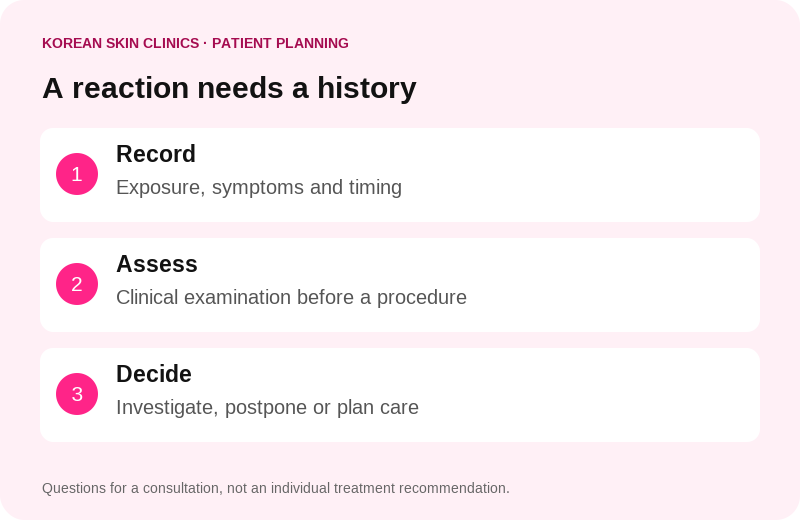
Write a short timeline of the most recent reaction. Note the product or exposure, where it touched your skin, when symptoms started, how they felt and what happened afterwards. Include photographs from different stages if you have them. Separate what you observed from what you think caused it: a reaction after a new serum is important information, but it does not by itself identify the responsible ingredient.
Contact dermatitis can involve direct irritation or an allergic response. Similar-looking symptoms can have different explanations, and some people have more than one relevant problem. A clinician uses the history and examination to decide whether further investigation is needed. Bring product names and ingredient lists rather than trying to eliminate every possible substance yourself. An accurate timeline is often more informative than a long list of products labelled bad for sensitive skin.
Read the evidence: NHS: contact dermatitis · SNUH: contact dermatitis
Know which kind of test is being discussed
A small product trial, a test area before a procedure and diagnostic patch testing serve different purposes. Ask the clinic which one it means. Medical patch testing is used to investigate delayed contact allergy; it involves selected substances and follow-up readings rather than simply applying a cream for a few minutes. A negative quick trial cannot promise that every subsequent exposure will be tolerated.
If formal testing is suggested, ask where it is performed, how many appointments are needed and how your travel dates fit the readings. The AAD describes an initial application and return visits, including a later reading because some reactions take time. Do not book the test on the assumption that all answers will be available before an early flight the next morning. Ask for the final interpretation in writing, including what the result does and does not establish.
Read the evidence: AAD: diagnostic patch testing · NHS: contact dermatitis diagnosis
Bring the products that help as well as those that hurt
A consultation becomes more practical when the clinician knows what you currently tolerate. Make a short list of your regular cleanser, moisturizer, sunscreen and prescribed treatments. Add occasional exposures such as masks, hair products, makeup, adhesives and professional treatments if they coincide with symptoms. Photos of ingredient labels are often easier to carry than multiple containers.
Explain how each product is used, not only its name. Mention whether you layered it with other products, changed how often you applied it, or used it on recently treated skin. Avoid deliberately reproducing a severe reaction to gather evidence for the visit. The aim is to give the clinician a useful record, not to perform your own challenge test. Ask which existing products can remain while the assessment proceeds so that uncertainty does not turn into constant experimentation.
Ask for a procedure-specific exposure plan
During a cosmetic visit, more than the headline device or injection touches your skin. Cleansers, antiseptics, topical anesthetics, gels, adhesives and aftercare products may also be involved. If you have reacted to a similar material, tell the treating team before the appointment and repeat the relevant history during the consultation. Do not assume a message to the booking desk has reached the person performing treatment.
Ask which materials are essential and whether a clinically appropriate alternative exists for a known problem. Request a record of what was used if a reaction occurs. This is not a request to omit safety measures or replace professional judgment; it helps the team assess the actual exposures. For a diagnosed allergy, bring the exact allergen name and previous test report rather than relying on a broad phrase such as allergic to cosmetics.
Choose a stopping point before you start
Before agreeing to an elective procedure, ask what finding would lead the clinician to postpone it. Discuss how an active rash, unexplained swelling or unresolved reaction changes the decision. If treatment is deferred, request the next step and the criteria for reconsidering it. A vague instruction to return when your skin is better is less useful than knowing what the clinician wants to review.
Keep the diagnostic and cosmetic goals separate. You may want the rash assessed now and an unrelated texture concern addressed later. That sequence gives you room to understand the first problem before adding new exposures. If you are offered several same-day procedures, ask whether each one is necessary and whether staging would make a subsequent reaction easier to interpret. You are allowed to leave with information and no procedure.
Make the recovery routine small enough to follow
Request a written list of the products and medicines intended for recovery, with their purpose and duration. Ask when your usual routine can resume and what to do if something stings or produces a rash. Do not add several new products simply because they are marketed as soothing or because you have access to Korean skincare shops during the trip.
The AAD notes that fragrance-free and unscented labels are not equivalent, and botanical ingredients can still be relevant to fragrance sensitivity. Product labels alone cannot guarantee suitability for your history. Ask the clinician to help you choose within a routine you can maintain after returning home. If a recommendation is unavailable in your country, ask what characteristics or ingredient restrictions matter so that a local clinician or pharmacist can help identify an appropriate alternative.
Read the evidence: AAD: testing skincare products
Respond to a reaction with a clear record and timely care
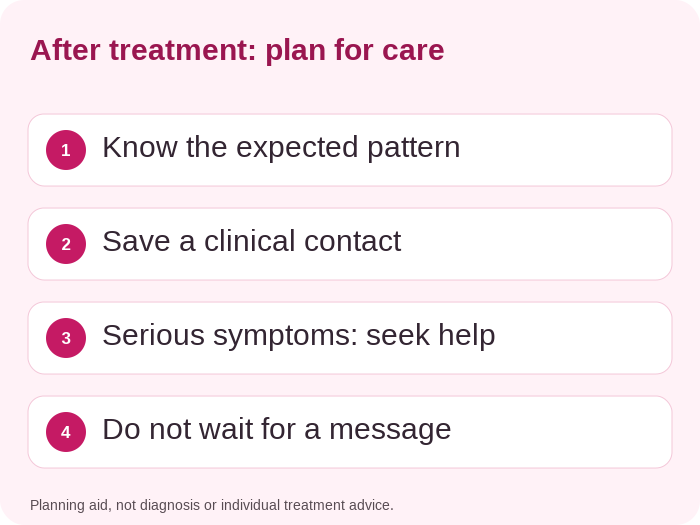
Before treatment, ask how to reach the clinic about a new rash and whether photographs are sufficient for the first review. Record when symptoms began, where they appeared and any products or medicines added since the procedure. Keep the original aftercare sheet. A careful chronology helps the clinician distinguish a developing complication from an expected recovery change without relying on memory.
Severe symptoms need medical attention rather than repeated home experimentation. Breathing difficulty or swelling of the mouth or throat requires emergency care. Do not wait for an international clinic to reply to a message. For a less urgent but worsening or persistent rash, arrange assessment locally if you have already left Korea. Avoid treating a new facial rash with someone else’s prescription; the appropriate treatment depends on the cause and location.
Read the evidence: AAD: allergic reactions and testing
Recommended listed clinic for assessment before cosmetic care
Delight Dermatology Clinic is a relevant listed option because its international website describes medical Skin Conditions services, including hives and atopic dermatitis, alongside cosmetic treatments. That combination provides a reason to request an assessment of recurrent skin reactions before discussing an elective procedure. Review the clinic profile and its official Skin Conditions page, then explain your symptoms when asking which appointment type is appropriate.
Ask directly whether the clinic can investigate your particular concern and whether referral for diagnostic contact-allergy patch testing is needed. Its listing of allergy-related services does not establish that every allergy test is available, and a blood allergy test should not be assumed to answer the same question as contact patch testing. This recommendation is based on service relevance, not proof of superiority. Confirm the treating clinician, consultation scope and follow-up arrangements before making a travel-dependent booking.
Read the evidence: Delight: Skin Conditions
Pay for the assessment you need
Ask for the consultation fee and whether any proposed investigation or follow-up is charged separately. If patch testing requires another provider, clarify how to obtain the referral and results. Compare the cost of the whole assessment pathway rather than a facial package that may not address your symptoms.
If you eventually proceed with cosmetic treatment, request a separate quote and consent discussion for that procedure. Keep the result of your skin assessment with your records so that future clinics do not repeat the same uncertainty. The most useful outcome is a plan you understand: which exposures matter, what care is appropriate now, what remains uncertain and how to revisit your cosmetic goals when your clinician considers it reasonable.
Describe symptoms rather than a label
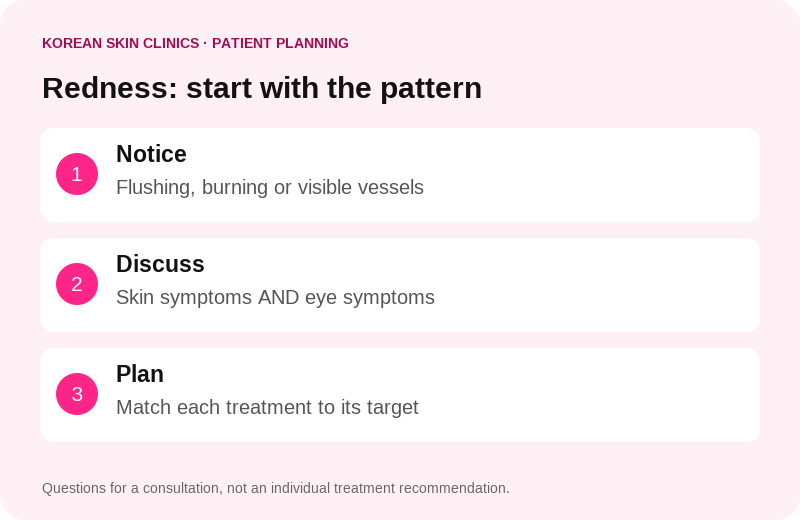
Sensitive skin is a useful description of your experience, but it does not identify one specific diagnosis. Tell the clinician whether the problem is burning, itching, dryness, redness or a rash, and when it occurs. Contact dermatitis can result from irritation or allergy. A cosmetic appointment should leave time to assess active symptoms before moving directly to an elective treatment.
Bring an ingredient record
Photograph the front and ingredient list of products that caused problems, including masks, hair products and sunscreens. Note how soon symptoms began and whether they improved after stopping the product. If a reaction affected the eyelids or lips, include makeup and fragranced products in the history. Avoid testing a new collection of products just before the visit, because that can make the timeline harder to interpret.
Ask whether to postpone
An active rash can change what the clinician recommends. Ask directly whether the skin should settle before a procedure and what finding would make it reasonable to proceed. If the doctor suggests investigation or treatment for dermatitis, request an explanation of the next step. A consultation that leads to postponement can still be valuable when it prevents an unsuitable procedure and establishes a clearer diagnosis.
Keep aftercare simple and explicit
Request the names of the products intended for the recovery period, how often to use them and what to do if they sting. Ask whether you should obtain them before treatment. Clarify when usual actives, makeup and sunscreen can be resumed for the specific procedure. Do not assume a product marketed as natural, soothing or hypoallergenic will necessarily be suitable for your individual history.
Arrange a response pathway
Before treatment, ask who will review a new rash and how quickly photographs or an in-person assessment can be arranged. Keep a record of what was applied in the clinic, including topical anesthetics and dressings when available. If a reaction occurs after departure, a written treatment record can help the clinician who sees you next understand the exposure and the timing.
Bring ingredient lists instead of replacing your routine abroad
Before a Korea appointment, photograph the labels of products used in the United States and list the reactions you have had, including timing and symptoms. Ask whether the visit should focus on diagnosis or testing before any elective procedure. Request instructions that distinguish products to continue, temporarily avoid or review with your prescriber. If new products are recommended, obtain their ingredients so you can discuss them after returning home. Avoid planning multiple new products and procedures together simply because the trip offers access to different brands; that can make a later reaction harder to explain.
A product test at home and a formal patch test answer different questions
If you are well and considering a new skin-care product, the American Academy of Dermatology describes a small-area trial before widespread use. This can help reveal that a product irritates your skin. It cannot tell you which ingredient caused a previous eruption or clear you for a laser, an injection, an adhesive dressing or an anesthetic. If you have already had a substantial reaction, ask a clinician before trying to reproduce it. Bring the packaging rather than deliberately provoking a new rash before your trip.

When a clinic proposes “patch testing,” ask for the actual test name. Is it medical testing for delayed contact allergy with a schedule of readings? Is it a small test area for a particular device? Or is it a trial of a topical product? Ask what a positive result would change, what a negative result cannot exclude and whether the necessary review visits fit the dates you will be in Korea.

Keep a separate list of products that you tolerate. Suppose a sunscreen and a moisturizer both say fragrance-free, but only one causes symptoms. The exact ingredient lists and timing help a dermatologist more than the shared front-label claim. In a US-to-Korea handoff, photograph both ingredient panels, note the country of purchase and retain the original names. A product family may have several formulations; similar names alone do not identify an allergen.
When the eyelids react but the new product went on your hands
A rash on the eyelids can be linked to something carried there by your fingers. Nail cosmetics, fragrance and hair products are among the exposures a dermatologist may ask about. A bare eyelid on the day of your appointment does not erase an exposure from earlier in the week. Photograph the rash when it is visible and note the interval between your nail appointment or a product change and the first itch, redness or swelling. Include whether both eyes were affected.
For a visit in Seoul, save the US packaging or salon product name where possible. Describe hand-to-face contact rather than trying to recreate the reaction. Reapplying a suspected product to the eyelid is an unsafe way to investigate it. Ask whether a medical evaluation for dermatitis, including formal patch testing if appropriate, should precede a cosmetic procedure near the eyes. Eye pain, light sensitivity or a change in vision needs prompt eye care where you are and should not wait for a scheduled cosmetic assessment.
Sources and clinical guidance · dermnetnz.org · Clinic profile · Official international consultation
An itchy outline where a dressing used to be
If your skin reacted after a biopsy or another procedure, sketch the dressing and the rash on the same piece of paper. Did the itch trace the sticky border, cover the absorbent center or extend beyond the whole dressing? How long after application or removal did it begin? Bring a photograph of the packaging if you have it, including the names of any cleanser, ointment or liquid adhesive used at the same visit. An outline offers a clue about contact; it cannot identify an allergen on its own. Pain that is worsening, spreading redness, drainage or fever after a procedure also needs prompt clinical assessment.
Tell the clinician if you have used a different tape or bandage comfortably since then. A dermatologist might consider formal patch testing if the pattern keeps recurring. Rosin, also called colophony, is one possible ingredient in adhesive products. Having a rash under a bandage does not establish rosin allergy, latex allergy or an allergy to every medical tape. Avoid experimenting by putting the suspected product back onto a fresh wound. If you are already wearing a postoperative dressing, ask its prescribing team how to change the plan safely.
Before booking treatment abroad, ask for the dressing plan in writing: what touches the skin, what holds it in place and what to do if it becomes itchy or wet. If patch testing has already identified an allergen, bring the original result with its ingredient names. A clinician in Seoul can use it even if a familiar U.S. brand is unavailable. Check who will answer questions after the return flight and how your home clinician can obtain the product record if a reaction appears several days later.
Patient questions
Does stinging mean I am allergic to a product?
Not necessarily. Irritation and allergy are different possibilities. Describe the timing, symptoms and product ingredients so the clinician can assess the reaction.
Should I test several calming products before my visit?
Avoid introducing several unfamiliar products together. Bring your current routine and reaction history so the clinician can interpret what is happening and advise suitable changes.